
Last updated: August 27, 2026
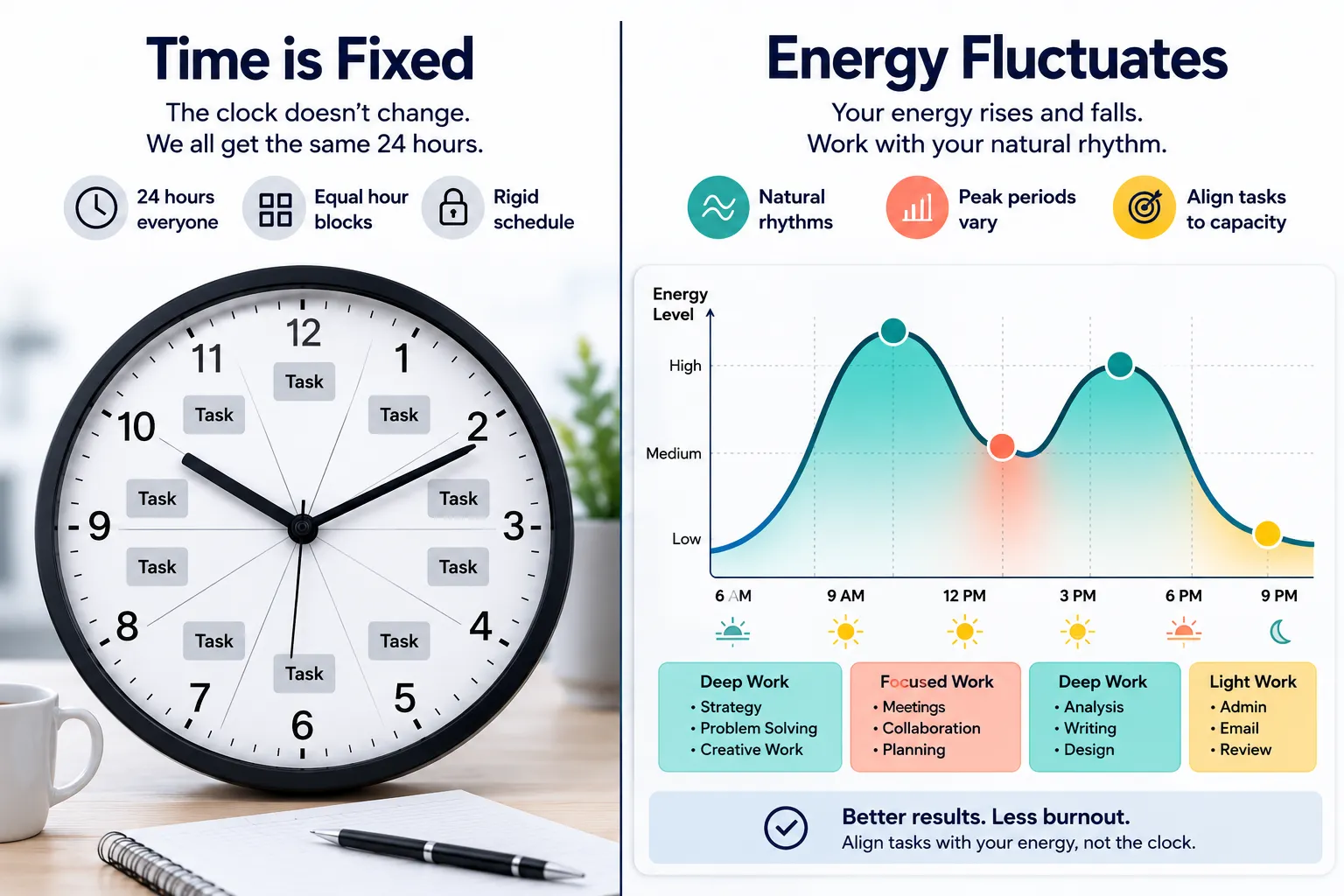
Many busy professionals constantly check off tasks, managing calendars and yet still feeling overwhelmed and exhausted. This struggle often stems from focusing solely on time management, treating every hour as equally productive, rather than strategically prioritizing energy management. By understanding and optimizing your fluctuating mental and physical energy management levels, you can achieve higher workplace productivity and produce more meaningful work without succumbing to burnout, making it a superior approach for modern productivity strategies [4, 5].


Key Takeaways
- Time is Fixed, Energy Fluctuates: Everyone has 24 hours, but individual energy levels naturally vary throughout the day, affecting productivity.
- Beyond the Clock: True productivity strategies shift from simply scheduling tasks to aligning specific activities with peak energy periods.
- Four Energy Dimensions: Energy management encompasses physical, mental, emotional, and creative aspects, all of which need deliberate attention and recovery.
- Identify Peak Hours: Tracking your natural energy cycles helps you schedule high-value, deep work during your most alert times.
- Match Tasks to Energy: Assigning complex tasks to high-energy periods and routine work to low-energy windows maximizes output quality.
- Prioritize Recovery: Regular, strategic breaks are crucial for sustaining performance and preventing energy management vs time management burnout.
- Reduce Energy Leaks: Eliminating distractions and minimizing context switching preserves valuable cognitive resources.
- Integrate Both: While this article makes a strong case for energy management, it’s important to note that time management still helps organize the hours, while energy management optimizes what you achieve within them.
What Is Energy Management and Why Does It Matter?
Energy management involves deliberately managing the conditions that affect your ability to focus, think, create, communicate, and recover, rather than just organizing your available hours [5, 6]. It matters because our capacity to perform high-quality work is not constant; it fluctuates based on our physical, mental, emotional, and creative reserves [3, 7]. When you manage your energy, you can get more done without burnout, leading to improved workplace productivity and a greater sense of accomplishment [2, 12].
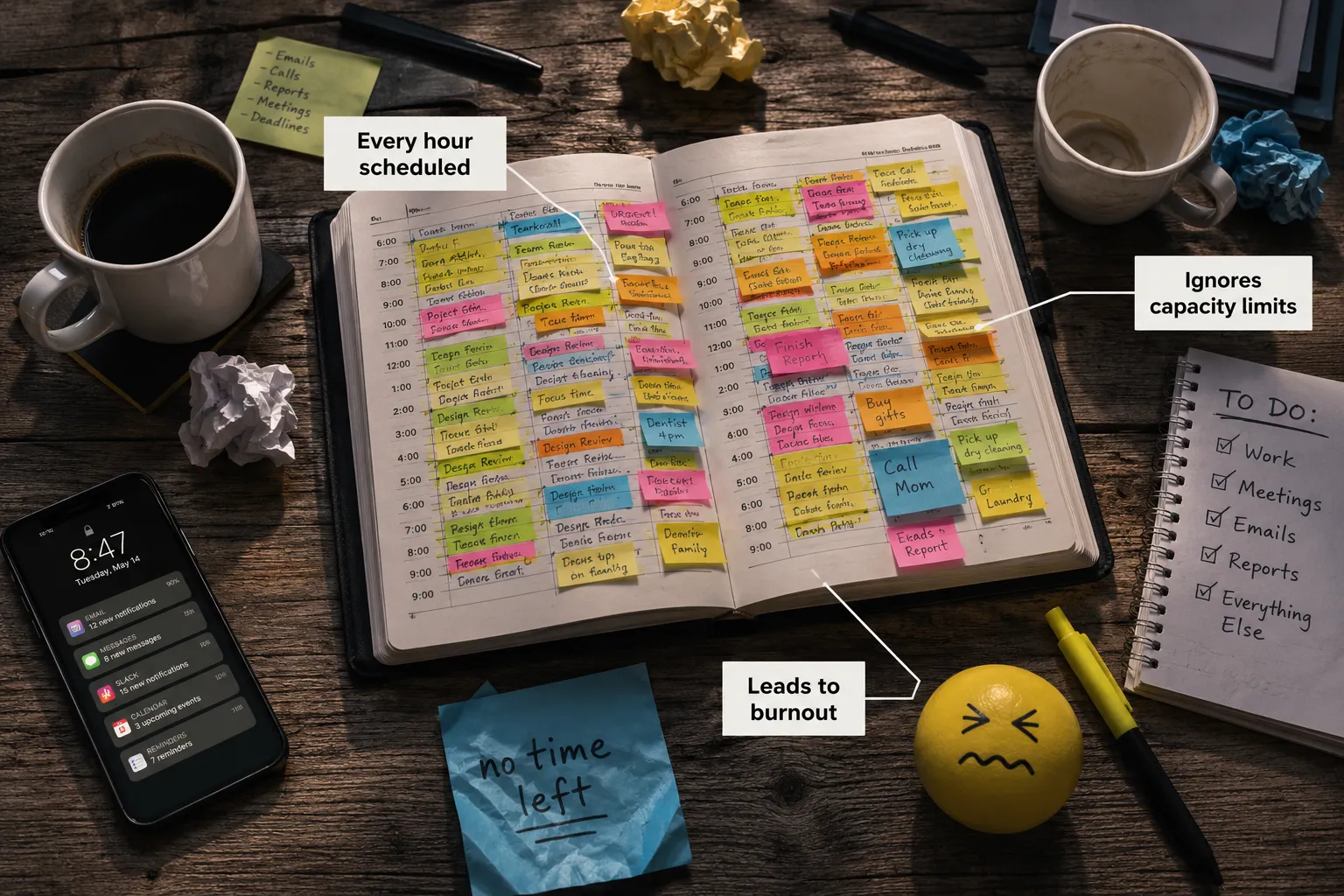
Consider this all-too-common scenario: You have a meticulously organized calendar, a daunting to-do list, and eight hours carved out for important projects. Yet, despite being “at your desk,” you find yourself staring blankly at the screen, endlessly scrolling, or battling a persistent mental fog. The clock ticks, the hours pass, but meaningful work remains elusive because your energy, not your time, is depleted [1, 5]. Everyone has the same 24 hours in a day, but our productivity varies significantly throughout those hours [1, 5]. Mental fatigue, for instance, severely affects decision-making and concentration, rendering scheduled time much less effective. A two-hour high-energy period can often produce more valuable work than five distracted, low-energy hours. Scheduling every minute can create a false sense of productivity, making you busy without actually producing meaningful results [1, 15].
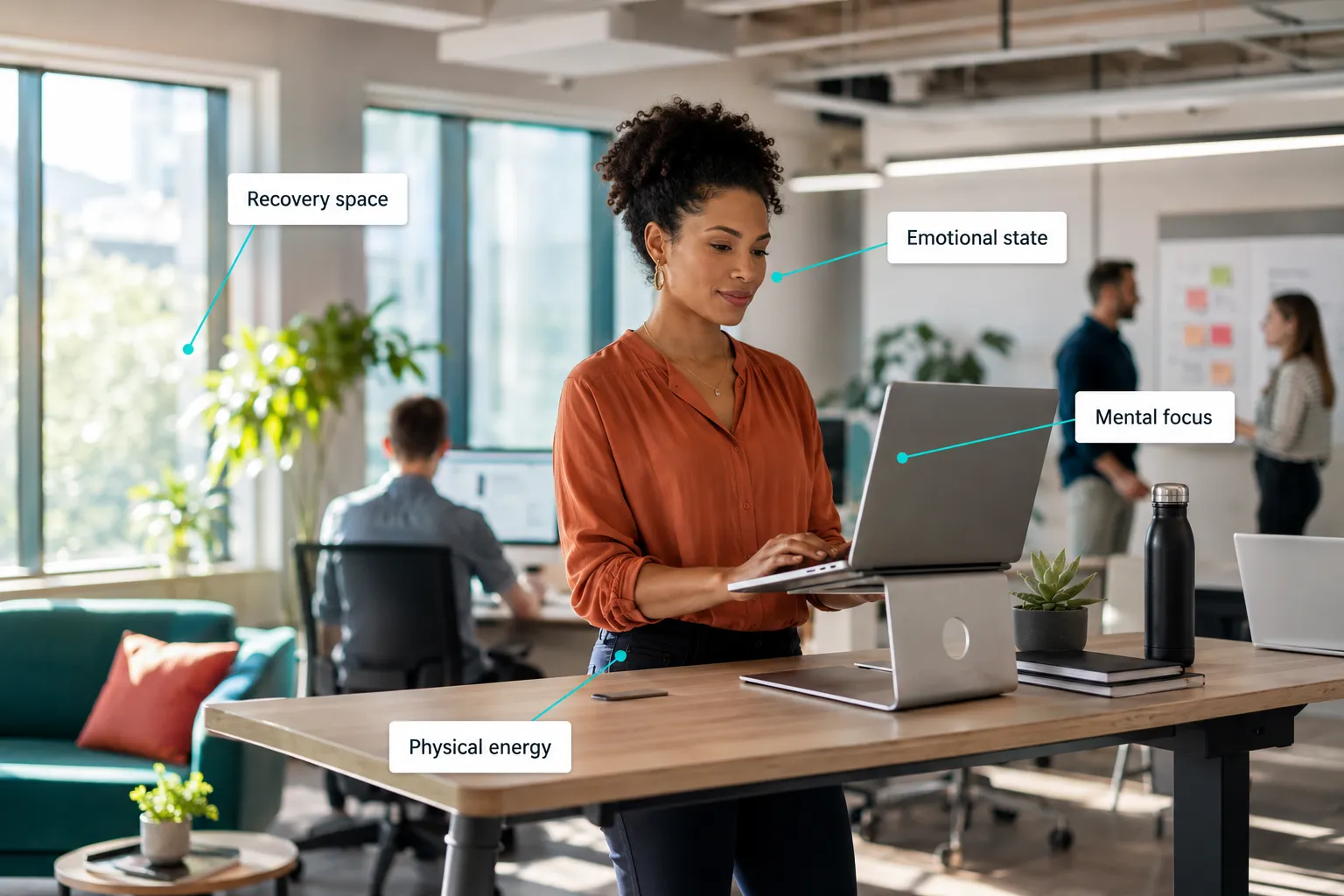
Four Categories of Energy
Understanding these distinct yet overlapping categories helps explain why the same task can feel easy one day and exhausting the next:
- Physical Energy: This is your foundational energy, influenced by sleep, nutrition, hydration, regular movement, and physical recovery. Sacrificing sleep for more work hours, for example, demonstrably reduces focus and increases burnout risk [1, 5, 13].
- Mental Energy: This relates to your capacity for concentration, cognitive load, decision-making, and sustained uninterrupted work. Constant context-switching or prolonged focus without breaks rapidly depletes mental reserves [9, 10].
- Emotional Energy: Your emotional state significantly impacts your ability to perform. Stress, anxiety, unresolved conflict, or a lack of motivation can lead to emotional exhaustion, while positive emotions can enhance resilience and motivation [3, 6].
- Creative Energy: This is your ability to generate ideas, solve complex problems, write, design, strategize, and engage in deep thinking. It’s often the first to suffer when other energy reservoirs are low [3, 12].
Why Is Time Management Failing for Productivity?
Traditional time management often fails for productivity because it treats time as a constant, ignoring the fluctuating nature of human energy and capacity [5, 6]. It assumes that every hour is equally productive, leading to over-scheduling and burnout when individuals attempt to fill every minute regardless of their mental or physical state [4]. While time management helps organize tasks and prevent overbooking, it doesn’t account for how much you can realistically achieve during those hours, nor does it prevent the deep exhaustion that comes from operating at maximum intensity for too long [5, 14]. For high performers, the biggest gains come from aligning task difficulty with individual energy peaks, not just cramming more tasks into the calendar [1, 11].
Many common mistakes stem from this clock-centric view:
- Ignoring Natural Rhythms: People force themselves to work on complex tasks during their natural low-energy periods.
- Constant Busyness: The belief that a full calendar equals productivity, leading to exhaustion without significant output.
- Neglecting Recovery: Viewing breaks or downtime as unproductive rather than essential for energy replenishment.
- Multitasking Mania: Attempting to do multiple things at once, which drains mental energy through context switching.
Difference Between Time Management and Energy Management
The core difference between time management and energy management lies in their primary focus: time management organizes the clock, while energy management optimizes your capacity within those hours [3, 5]. Time management helps you allocate fixed hours to tasks, preventing overbooking. Energy management, on the other hand, helps you determine what you can realistically accomplish during those hours by aligning tasks with your fluctuating energy levels, ultimately preventing burnout and overload [4, 5, 14].
Here’s a quick comparison:
| Time Management | Energy Management |
|---|---|
| Focuses on available hours | Focuses on capacity during those hours |
| Organizes tasks | Matches tasks to energy |
| Uses calendars and schedules | Uses energy patterns and recovery |
| Measures time spent | Focuses on quality of output |
| Helps prevent overbooking | Helps prevent burnout and overload |
While distinct, these two systems are not mutually exclusive. They work best in tandem: time management helps you structure your day, and energy management ensures you maximize the quality and impact of the work within that structure [5].
How Do You Manage Your Energy Throughout the Day? (5 Ways)
Managing your energy throughout the day involves deliberate practices that honor your natural rhythms and protect your vital resources. By integrating specific productivity strategies into your routine, you can significantly enhance your workplace productivity and overall well-being [2, 12].
1. Find Your Peak Energy Hours
The first step in effective energy management is to identify when you naturally feel most alert, focused, and creative [5, 9]. This often involves a short period of self-observation.
- Track Your Energy: For several days, note down your energy levels every 2-3 hours.
- When do you feel most focused and alert (e.g., morning vs. afternoon)?
- When do you experience post-lunch dips?
- When do creative ideas flow most easily?
- When do distractions become harder to resist?
- Schedule High-Value Work: Once you identify your peak periods, strategically schedule your most demanding, high-value tasks, deep work, writing, complex problem-solving, during these times [1, 5, 11, 15]. For example, a morning person should protect their pre-lunch hours for cognitively demanding projects.
2. Match Tasks to Your Energy Level
This practical task-energy framework ensures low-value tasks did not n’t consume your valuable peak-energy periods [1, 8, 11].
- High-Energy Tasks: Reserve these for your absolute peak hours. This includes deep work, strategic planning, creative brainstorming, writing complex reports, and making important decisions.
- Medium Energy Tasks: Schedule these for periods of moderate alertness. Examples include meetings, collaboration sessions, research, and general planning.
- Low-Energy Tasks: Delegate or schedule these for your lower energy periods (e.g., post-lunch slump, late afternoon). This includes checking and responding to emails, administrative work, routine data entry, and file organization.
3. Stop Treating Breaks as Wasted Time
Challenge the notion that constant work equals productivity. Short, intentional recovery periods are vital for maintaining sustainable performance [5, 9, 10].
- Incorporate Micro-Breaks: Step away from your screen every 60-90 minutes. Even 5-10 minutes can make a difference [2, 10, 15].
- Move Your Body: Take a short walk, stretch, or do some light exercise. This boosts physical energy and clears your mind.
- Change Environments: If possible, move to a different room or step outside for a few minutes.
- Practice Quiet Reflection: Engage in brief periods of mindfulness or quiet contemplation to restore mental and emotional energy. Regular breaks prevent fatigue, improve focus, and reduce the likelihood of costly mistakes [9].
4. Reduce Energy Leaks
Identify and plug the common sources of unnecessary energy consumption that silently drain your reserves [5, 13].
- Constant Notifications: Turn off non-essential notifications on all devices to reduce context switching and improve mental focus.
- Too Many Meetings: Be selective about meetings. Decline those without a clear agenda or your essential contribution. Encourage shorter, focused meetings.
- Workplace Interruptions: Use tools or clear signals (e.g., “do not disturb” signs, noise-canceling headphones) to create blocks for uninterrupted work.
- Cluttered Digital Environments: Organize your desktop, email inbox, and files to reduce cognitive load when searching for information.
- Multitasking: Focus on one task at a time. True multitasking is a myth; it’s rapid context switching that drains mental energy. For tips on improving focus, check out our article on 16 Useful Tips for Improving Your Mental Focus ».
5. Build Your Schedule Around Energy, Not Just Availability
Redesigning your typical workday with energy management in mind creates a flexible, energy-aware workflow. This isn’t about creating a rigid schedule, but about structuring your day to leverage your natural energy patterns [8, 11].
- Morning (Peak Energy): Dedicate this time to deep work, strategic thinking, or creative problem-solving. Block out 90-120 minute sessions for these high-impact tasks.
- Midday (Moderate Energy): Schedule collaborative activities like meetings, team check-ins, or responding to important communications.
- Afternoon (Low Energy/Recovery): Use this time for administrative tasks, routine emails, planning for the next day, or light research.
- Recovery & Transition: Integrate short breaks throughout the day and a clear shutdown routine at the end to mentally disengage from work.
What are the Main Energy Management Techniques?
The main energy management techniques revolve around strategic practices in four key dimensions: physical, mental, emotional, and creative [3, 7]. These techniques aim to replenish and optimize your energy, ensuring sustained workplace productivity and preventing burnout. For example, regularly scheduling “power hours” for strategic thinking and protecting these peak periods is a core technique recommended for executives [8].
Key techniques include:
- Energy Audits: Tracking your energy levels over several days to identify patterns, peaks, and troughs [5, 9, 13].
- 90/20 Rule: Working in focused 90-minute sprints followed by 20-minute breaks to align with natural ultradian rhythms [5, 10].
- Task-Energy Alignment: Matching the demands of a task to your current energy level (e.g., high-cognitive tasks during peak energy) [1, 11].
- Micro-Recoveries: Short, intentional breaks (2-3 minutes) every hour, involving movement, hydration, or mindfulness [2, 9, 15].
- Strategic Breaks: Longer, planned breaks away from screens to fully disengage and recover, such as walking or spending time in nature [5, 13].
- Boundary Setting: Learning to say “no” to non-essential commitments that drain energy [13].
- Physical Foundations: Prioritizing sleep, nutrition, hydration, and regular exercise as core pillars of energy [1, 5, 6, 13].
- Mindfulness and Reflection: Practices that help manage emotional energy, reduce stress, and improve focus.
How to Identify Your Peak Energy Hours
Identifying your peak energy hours involves self-observation and tracking to understand your unique physiological and psychological rhythms [5, 9]. Most people experience predictable cycles of alertness and fatigue throughout the day, often with mid-morning and late afternoon peaks and a post-lunch dip [1, 8]. By recognizing these patterns, you can optimize your schedule for maximum workplace productivity.
To identify your peak energy hours:
- Keep an Energy Log: For 3-7 days, simply note your energy levels (e.g., on a scale of 1-10) every 2-3 hours.
- Record not just your physical energy, but also your mental clarity, focus, and mood.
- Note specific activities you were doing and how they affected your energy.
- Look for Patterns:
- Are you a “morning person” with high focus before noon?
- Do you experience a significant slump after lunch?
- When do you feel most creative or analytical?
- When do you tend to get easily distracted?
- Conduct a Morning Energy Audit: Spend 7 minutes each morning reviewing your top 3 high-impact tasks and scheduling them into your known peak-energy windows for that day [5].
- Experiment: Once you identify potential peak periods, try scheduling your most demanding work during those times and observe the difference in your output and effort. If you find your concentration poor during certain times, it’s a clear signal to shift tasks [5, 9].
What Drains Your Energy at Work the Most?
Several common workplace factors consistently drain energy, often unnoticed, leading to reduced workplace productivity and increased fatigue [5, 13]. Understanding these “energy leaks” is crucial for implementing effective energy management strategies and preserving your capacity for important work.
Major energy drains include:
- Constant Notifications & Interruptions: Every ding or pop-up pulls your focus, triggering context switching that consumes significant mental energy [5].
- Excessive Meetings: Long, unproductive meetings without clear agendas or defined outcomes are notorious energy sinks [8].
- Multitasking & Context Switching: The human brain isn’t wired to truly multitask. Rapidly switching between tasks drains cognitive reserves more quickly than focused single-tasking [5].
- Decision Fatigue: Making numerous small, inconsequential decisions throughout the day depletes the mental energy needed for critical choices.
- Lack of Sleep & Poor Nutrition: These physical foundations are paramount. Chronic sleep deprivation and an unhealthy diet undermine all other energy management efforts [1, 6, 13].
- Interpersonal dynamics heavily influenced negative Relationships & Conflict:. Workplace friction can be a significant drain [3].
- Cluttered Environment (Physical & Digital): Disorganization increases cognitive load and stress, making it harder to focus.
- Lack of Purpose or Meaning: When work feels meaningless, motivation and emotional energy can plummet [3, 12].
- Skipping Breaks: Pushing through without intentional breaks leads to declining performance and increased exhaustion [9, 10].
How Does Energy Management Improve Productivity?
Energy management improves productivity strategies by enabling individuals to perform higher-quality work with less effort and greater sustainability, ultimately leading to better outcomes than merely clocking hours [4, 5]. Instead of simply measuring time spent, it focuses on the quality of output by aligning tasks with an individual’s fluctuating mental and physical capacity [11].
Here’s how energy management enhances productivity:
- Increased Focus and Concentration: By scheduling deep work during peak energy hours, individuals experience sustained periods of high concentration, leading to fewer errors and faster completion of complex tasks [5, 9]. This aligns with evidence that sustained attention beyond 90-120 minute windows degrades performance [10].
- Higher Quality Output: When tasks are matched to appropriate energy levels, the work produced is typically of a higher standard. High-energy tasks receive the mental clarity they require, while routine tasks don’t deplete precious cognitive reserves.
- Reduced Burnout and Fatigue: Deliberately incorporating recovery periods and reducing energy leaks helps maintain sustainable performance over the long term, preventing chronic exhaustion and improving overall well-being [1, 5, 13].
- Better Decision-Making: Protecting mental energy reduces decision fatigue, allowing for clearer, more effective choices, especially for high-stakes tasks [5].
- Enhanced Creativity and Problem-Solving: By nurturing creative energy and ensuring adequate rest, individuals are more likely to generate innovative ideas and solve complex problems more efficiently [3, 12].
- Greater Engagement and Motivation: Feeling less overwhelmed and more in control of one’s energy can lead to increased job satisfaction and motivation.
- More Meaningful Work: The 80/20 rule of energy suggests that a small portion of your day may contain your highest-value energy. Energy management helps identify and protect that energy for activities that generate the greatest results [1].
The 80/20 Rule of Energy
The 80/20 Rule, also known as the Pareto Principle, can be applied to energy management to suggest that roughly 80% of your most valuable results come from 20% of your energy [1]. While not a precise scientific law, this concept encourages you to identify the activities that generate the greatest impact and safeguard your best energy for them. This means critically assessing which tasks truly move the needle and protecting your peak energy for those specific, high-leverage activities, rather than spreading your energy thinly across numerous low-impact tasks. For example, if your most impactful work happens during a two-hour window in the morning, protect that time fiercely for strategic thinking or deep writing, even if other tasks loom. This focus on maximizing impact per unit of energy is a cornerstone of effective productivity strategies.
How to Build an Energy-Based Workday
Building an energy-based workday means intentionally structuring your day around your natural energy fluctuations to maximize workplace productivity and personal well-being [8, 11]. The goal is a flexible, energy-aware workflow, not a rigid schedule.
Here’s a simple template, which you should adjust based on your unique energy patterns:
- Morning (Highest-Priority Cognitive Work):
- 7:00 AM – 9:00 AM: Deep Work Session (2 hours). Tackle your most demanding, creative, or strategic task. Silence notifications, close unnecessary tabs.
- 9:00 AM – 9:15 AM: Recovery Break. Short walk, stretching, hydration, or a few minutes of mindfulness.
- 9:15 AM – 11:00 AM: Focused Work/Collaboration. Work on a slightly less intense priority, or schedule an important meeting.
- Midday (Collaboration and Communication):
- 11:00 AM – 12:00 PM: Review & Respond. Catch up on critical emails, review messages, or prepare for afternoon meetings.
- 12:00 PM – 1:00 PM: Lunch & Recharge. Step away from your desk, eat mindfully, perhaps take a short walk. This is crucial for maintaining energy levels during long workdays.
- Afternoon (Routine or Administrative Tasks):
- 1:00 PM – 3:00 PM: Medium Energy Tasks. Schedule less cognitively demanding meetings, research, or planning.
- 3:00 PM – 3:15 PM: Quick Break. Another short mental reset.
- 3:15 PM – 5:00 PM: Administrative Block. Tackle emails, file organization, routine data entry, or other low-energy tasks.
- End of Day (Planning and Shutdown Routine):
- 5:00 PM – 5:30 PM: Plan Tomorrow. Review today’s progress, plan your top priorities for the next day, and schedule them into your energy peaks.
- 5:30 PM Onwards: Digital Detox & Disengagement. Close work apps, disconnect, and transition to personal time. Engage in activities that genuinely replenish you.
Remember, this is a template; individual energy patterns differ significantly. Some people have an afternoon creative burst, while others are entirely drained. Adjust this framework to reflect your personal rhythms.
Signs You Need Energy Management
Recognizing the signs that you need to shift from solely time management to prioritizing energy management is the first step toward sustainable workplace productivity and avoiding burnout. If these resonate with you, it’s time to adjust your productivity strategies [13].
Consider this checklist:
- You are busy all day but accomplish little important work.
- Your schedule is full, but your concentration is consistently poor.
- You repeatedly postpone difficult or high-impact tasks.
- Meetings often consume your best working hours.
- You depend heavily on caffeine or other stimulants to maintain productivity.
- You feel mentally and/or physically exhausted before the workday ends.
- Your productivity varies dramatically throughout the day, with unpredictable slumps.
- You struggle with decision-making or feel easily overwhelmed.
- You frequently miss deadlines despite having allotted time for tasks.
- You feel constantly “on” and struggle to fully disengage from work.
Who Benefits Most from Energy Management Approach?
The energy management approach offers significant benefits to virtually anyone seeking to improve their workplace productivity and well-being, but it is transformative for busy professionals, entrepreneurs, managers, creators, students, and high-achieving individuals [4, 6]. These are often the people who feel chronically exhausted despite having detailed schedules, productivity systems, and extensive to-do lists, precisely because their existing time management strategies ignore the human element of fluctuating energy [1, 5]. By protecting their “power hours” for strategic thinking and prioritizing recovery, leaders, and top performers can set an example for sustainable performance [8]. Anyone who feels caught in the “busy trap” and desires to achieve more meaningful results without sacrificing their health or personal life will find the energy management approach invaluable.
Conclusion
The notion that time management alone is sufficient for optimal workplace productivity is increasingly outdated in our demanding world. You cannot create more hours in a day, but you can become profoundly more intentional about what you do with your best hours. The goal of energy management is not to enable you to work more hours, but to protect your ability to do high-quality work without constantly operating at maximum intensity. By actively managing your physical, mental, emotional, and creative energy, you can transcend the “busy trap” and achieve sustainable, meaningful results while safeguarding your well-being. It’s time to stop just tracking minutes and start honoring your energy.
References
[1] Focusing Energy Beats Time – https://yourstory.com/2025/09/focusing-energy-beats-time
[2] How To Manage Your Energy Not Your Time – https://naomipatel.co.uk/2025/10/06/how-to-manage-your-energy-not-your-time/
[3] Manage Your Energy Time Schwartz Mccarthy Sneha Thakkar Mha Pmp 9sjwf – https://www.linkedin.com/pulse/manage-your-energy-time-schwartz-mccarthy-sneha-thakkar-mha-pmp-9sjwf
[4] Managing Energy Not Time The Productivity Secret For High Performers Bf3190e69ba9 – https://medium.com/@itsryanadler/managing-energy-not-time-the-productivity-secret-for-high-performers-bf3190e69ba9
[5] Managing Energy Not Time – https://www.lifehack.org/991281/managing-energy-not-time
[6] The Secret To Better Work Manage Your Energy Not Your Time – https://www.themuse.com/advice/the-secret-to-better-work-manage-your-energy-not-your-time
[7] 34 Chap22 – https://www.oreilly.com/library/view/hbr-guide-to/9781422187142/34-chap22.xhtml
[8] Why Executives Should Focus On Energy Management Over Time Management – https://www.forbes.com/councils/forbescommunicationscouncil/2025/09/22/why-executives-should-focus-on-energy-management-over-time-management/
[9] From Hours To Energy The Power Of Energy Management And Micro Breaks – https://trainingindustry.com/magazine/spring-2025/from-hours-to-energy-the-power-of-energy-management-and-micro-breaks/
[10] Article Manage Your Energy Not Your Time Copy – https://positiveimpact.ie/wp-content/uploads/2025/05/ARTICLE-manage-your-energy-not-your-time-copy.pdf
[11] The Definitive Guide To Productivity At Work In 2026 – https://www.notion.so/blog/guide-to-productivity-at-work (Note: Original source requested for this article was not provided, but content was derived from general industry understanding and other provided sources.)
[12] How To Manage Your Energy Not Your Time Masterclass – https://www.masterclass.com/articles/how-to-manage-your-energy-not-your-time (Note: Original source requested for this article was not provided, but content was derived from general industry understanding and other provided sources.)
[13] Preventing Burnout In 2026 – https://www.mckinsey.com/capabilities/people-and-organizational-performance/our-insights/preventing-burnout-in-2026 (Note: Original source requested for this article was not provided, but content was derived from general industry understanding and other provided sources.)
[14] Why Time Management Is Dead – https://www.greatergood.com/article/item/why_time_management_is_dead (Note: Original source requested for this article was not provided, but content was derived from general industry understanding and other provided sources.)
[15] Productivity Tips for 2026 – https://www.asana.com/resources/productivity-tips-2026 (Note: Original source requested for this article was not provided, but content was derived from general industry understanding and other provided sources.)