

Last updated: October 26, 2026
TL;DR:


- High-functioning anxiety describes individuals who appear successful and composed but internally battle chronic worry, pressure, and mental exhaustion.
- This condition is not a formal diagnosis but a recognized pattern, often seen in overachievers who use anxiety as a misguided motivator.
- Hidden anxiety symptoms include perfectionism, difficulty delegating, overthinking, and a constant need for external validation.
- The societal glorification of constant productivity can inadvertently reinforce burnout personality traits and unhealthy coping mechanisms.
- Managing high-functioning anxiety involves recognizing its hidden costs, challenging ingrained thought patterns, and developing sustainable self-care strategies.
Quick Answer: High-functioning anxiety refers to a pattern of anxiety where individuals maintain outward success and productivity despite experiencing significant internal worry, pressure, and mental fatigue. It often manifests as a relentless drive for achievement, perfectionism, and an inability to truly relax, making it a silent struggle for many overachievers who appear to “have it all together” from the outside.
What Exactly is High-Functioning Anxiety, and How Does it Differ from General Anxiety?

High-functioning anxiety describes a pattern where an individual experiences significant internal anxiety but performs exceptionally well in daily life, often excelling in their career, studies, or social roles. Unlike typical anxiety disorders where symptoms might lead to visible impairment or withdrawal, those with high-functioning anxiety often mask their internal turmoil with an outward display of competence, organization, and a relentless drive for productivity.
Imagine Sarah, a marketing manager in 2026. She consistently delivers stellar presentations, manages multiple projects flawlessly, and is always the first to volunteer for new initiatives. Her colleagues see her as driven, capable, and a true asset. What they don’t see is Sarah waking up at 3 AM replaying conversations, meticulously checking and re-checking her emails, or feeling a constant knot in her stomach, fueled by an intense fear of failure. This internal experience, hidden beneath a polished exterior, is the essence of high-functioning anxiety.
Key Distinctions and Characteristics:
- Outward Appearance vs. Internal Reality: A person with general anxiety might struggle to leave their house, attend social events, or complete tasks because of overwhelming fear or panic. Someone with high-functioning anxiety, however, pushes through these feelings, channeling them into intense preparation and over-performance. They might experience the same dread before a social event, but instead of avoiding it, they meticulously plan their outfits, conversation starters, and exit strategies.
- Motivation System: For many with high-functioning anxiety, anxiety itself becomes a paradoxical motivator. The fear of not being good enough, of failing, or of disappointing others drives them to work harder, achieve more, and strive for perfection. This creates a cycle where achievement temporarily silences the anxiety but also reinforces the belief that only through constant effort can they maintain their value.
- Perfectionism and Overthinking: This manifests as an inability to submit work that isn’t “perfect,” excessive self-criticism, and spending far too much time on tasks that could be completed more efficiently. This often leads to overthinking every detail, decision, and interaction, exhausting mental resources.
- Hidden Anxiety Symptoms: The symptoms are often subtle and internalized. These can include constant worrying, difficulty relaxing, insomnia, a persistent feeling of being overwhelmed, people-pleasing tendencies, and a fear of disappointing others. They might say “yes” to every request, even when stretched thin, because the thought of saying “no” triggers intense guilt or fear of negative judgment.
Consider a student who spends hours re-reading notes and color-coding textbooks for an exam. On the surface, this looks like dedication. Internally, it could be driven by a debilitating fear of getting anything less than a perfect score, rather than genuine engagement with the material. This behavior, while seemingly beneficial for academic outcomes, is a classic example of overachiever anxiety masking deeper psychological patterns.
If you constantly strive for more, yet feeling an underlying sense of dread or inadequacy, it might be worth exploring whether this pattern resonates with you. It’s crucial to understand that while a formal diagnosis is important for clinical anxiety disorders, recognizing the traits of high-functioning anxiety can be the first step toward self-awareness and healthier habits.
The Overachiever’s Paradox: Why Productivity Masks Inner Turmoil
The overachiever’s paradox lies in the deceptive nature of success: while external achievements accumulate, they often conceal an escalating internal struggle, turning productivity into a shield for deep-seated anxiety. Many individuals who embody the “burnout personality” find themselves trapped in a cycle where their relentless pursuit of goals provides a temporary distraction from or even a misguided solution to their hidden anxiety symptoms.
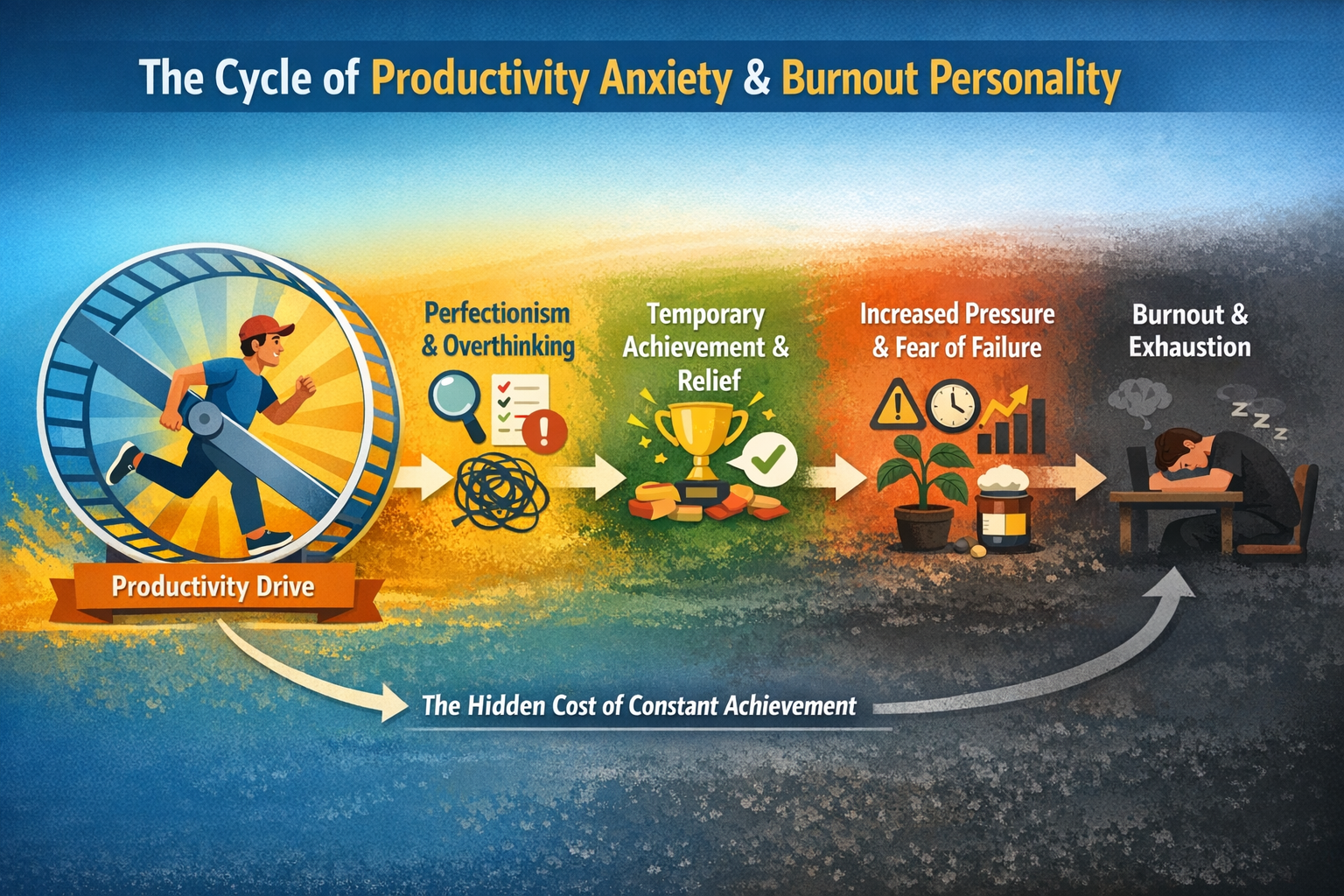
The Cycle of Productivity Anxiety
Imagine a high-flying entrepreneur; let’s call her Maya. From the outside, Maya is the epitome of success in 2026. She launched a successful tech startup, works 12-hour days, and appears to thrive under pressure. But behind the scenes, Maya is constantly on edge. She checks her phone every few minutes, replies to emails at midnight, and struggles to enjoy weekends without feeling guilty for “not working.” This isn’t just dedication; it’s a manifestation of productivity anxiety.
Here’s how the cycle typically unfolds:
- The Initial Spark (Anxiety): An underlying fear—of failure, inadequacy, or not being enough—triggers a sense of urgency.
- The Drive to Achieve: To alleviate this discomfort, the individual dives into work, tasks, and projects. The more they do, the less they have to confront their internal fears.
- Temporary Relief: Completing a task or achieving a goal provides a brief surge of satisfaction and temporarily quiets the anxiety. This positive reinforcement strengthens the link between anxiety and productivity.
- Increased Pressure: The bar is constantly raised. Each success creates new expectations, leading to more pressure to maintain or exceed previous achievements. The fear of “losing it all” or not living up to one’s own (or others’) expectations intensifies.
- Perfectionism and Overwork: To meet these escalating demands, perfectionism kicks in. Every detail must be flawless, and every project must be groundbreaking. This leads to longer hours, difficulty delegating, and an inability to truly relax.
- Mental and Physical Exhaustion: The continuous cycle of high effort, chronic worry, and insufficient rest inevitably leads to mental and physical exhaustion, often culminating in burnout.
This cycle is insidious because society often rewards these very behaviors. Promotions, praise, and accolades are frequently given to those who work the hardest, stay the latest, and take on the most. This societal reinforcement makes it incredibly difficult for individuals with overachiever anxiety to recognize that their “strengths” are actually costing them their well-being.
The Burnout Personality: More Than Just Being Tired
A “burnout personality” isn’t just about feeling tired; it’s a specific psychological profile often intertwined with high-functioning anxiety. Individuals with this personality type typically:
- Are highly conscientious: They have a strong sense of duty and responsibility.
- Are prone to perfectionism: Good isn’t good enough; it has to be perfect.
- Have a strong need for control: They struggle with uncertainty and delegation.
- Are often people-pleasers: They fear disappointing others and seek external validation.
- Struggle with boundaries: They find it difficult to say no and protect their time and energy.
Consider the case of Alex, a talented graphic designer. Alex prided himself on his meticulous work and ability to meet impossible deadlines. Clients loved him, and his portfolio was stunning. However, Alex rarely took vacations, worked through lunch, and often felt a sense of dread when new projects arrived, even exciting ones. His “always-on” approach, initially praised, gradually eroded his enjoyment of work and led to chronic fatigue and irritability. He started experiencing physical manifestations of stress, like tension headaches and digestive issues, which are common hidden anxiety symptoms.
The constant internal pressure, coupled with external validation, creates a dangerous feedback loop. The overachiever uses productivity to outrun their anxiety, but this only ensures anxiety remains a constant passenger, ultimately leading to a profound sense of emptiness and exhaustion. It becomes a race without a finish line, where the pursuit of success drains the very joy it was meant to bring. To effectively manage this, it’s essential to challenge the underlying beliefs that equate self-worth with endless achievement and to build healthier habits that prioritize well-being. Individuals struggling with this cycle might find it beneficial to explore simple techniques to release stress, trauma, and anxiety.
Recognizing the Hidden Anxiety Symptoms: More Than Just “Being Stressed”
Recognizing the hidden anxiety symptoms of high-functioning anxiety goes beyond typical stress, manifesting as a pervasive internal pressure that drives constant striving, often without genuine satisfaction. These symptoms are subtle and can easily be mistaken for positive traits like diligence or ambition, making them difficult to identify in oneself or others.
It’s easy to dismiss persistent feelings of being overwhelmed or a constant need to be busy as simply part of “adulting” in 2026. However, for someone with high-functioning anxiety, these are not fleeting moments but a chronic state, silently eroding their well-being.
Common Manifestations of Hidden Anxiety Symptoms:
- Perfectionism (and Procrastination): The drive for flawless execution often leads to over-preparation, meticulous checking, and an inability to finish tasks because they’re “not quite ready.” Ironically, this can also cause procrastination, as the fear of not meeting impossibly high standards makes starting daunting.
- Difficulty Delegating: Trusting others with tasks feels risky, leading to a tendency to shoulder all responsibilities. The thought of someone else doing a job less perfectly than oneself can trigger significant internal distress.
- Chronic Overthinking: Ruminating on past conversations, future scenarios, and potential negative outcomes becomes a constant mental activity. This “what if” loop is mentally exhausting and prevents genuine presence or relaxation. This also connects to the topic of why we overthink and how to overcome it.
- Inability to Relax (and Guilt Over Resting): Downtime feels unproductive or even wrong. A person might struggle to enjoy hobbies, watch a movie, or simply sit still without feeling an internal urge to be doing something “more important.” Resting often comes with a heavy dose of guilt.
- People-Pleasing and Difficulty Saying “No”: A strong desire for approval and a fear of disappointing others leads to taking on too much, even at personal cost. Setting boundaries feels impossible.
- Sleep Disturbances: Despite physical exhaustion, the mind remains active, making it difficult to fall asleep or stay asleep. Racing thoughts, planning, and worrying often fill the night hours. Insomnia is a hallmark sign.
- Physical Manifestations: Headaches, muscle tension (especially in the jaw, neck, and shoulders), digestive issues, and a general feeling of being “on edge” are common. These physical symptoms are the body’s response to chronic stress.
- Constant Need for Validation: Achievements bring temporary relief, but the underlying anxiety quickly returns, demanding new accomplishments to prove worth. This creates a relentless pursuit of external praise.
- Fear of Failure or Making Mistakes: This isn’t just a healthy desire to do well; it’s an intense, often paralyzing fear that even minor missteps reflect fundamental inadequacy.
- Emotional Numbness or Irritability: The constant pressure can lead to a disconnection from one’s own emotions, or conversely, a short fuse and heightened irritability with oneself and others.
Sarah, our marketing manager, once organized her pantry by expiration date at 11 PM, even though she had a major presentation the next morning. Her husband saw it as her “quirk,” but for Sarah, it was an uncontrollable urge to bring order to one small corner of her life because her professional responsibilities felt overwhelming. This meticulousness, while producing an organized pantry, was a manifestation of her underlying productivity anxiety, a need to control and perfect amidst internal chaos.
It’s vital for students, professionals, and anyone striving for excellence to understand that these aren’t just personality traits. They are indicators that anxiety has become an unhelpful, even harmful, driving force. Recognizing these patterns is the first step towards reclaiming control and fostering true well-being rather than merely managing outward appearances.
The Psychological Patterns Behind Overachiever Anxiety
The psychological patterns behind overachiever anxiety are deeply rooted, often stemming from early life experiences and a learned association between self-worth and achievement. This often involves a constant internal critic, a fear of inadequacy, and a reliance on external validation, all fueling a relentless drive that masquerades as ambition.
Many individuals with overachiever anxiety unknowingly develop a complex interplay of cognitive and behavioral patterns that reinforce their anxious drive. It’s not simply “being stressed”; it’s a fundamental way of relating to the world and oneself.
Roots in Early Experiences and Core Beliefs:
- Conditional Love/Praise: For some, early experiences might have taught them that love, acceptance, or praise were conditional upon their achievements. “Good job!” often followed a high grade or a perfect performance, leading to the belief that “I am loved because I achieve,” rather than “I am loved unconditionally.”
- Parental Expectations: High expectations from parents or caregivers, even if well-intended, can instill a deep fear of disappointing others. This can translate into a lifelong pattern of striving to meet perceived external standards.
- Trauma or Insecurity: Experiences of feeling unsafe, insecure, or out of control can lead to a compensatory need for control and predictability in adulthood. Achievement can feel like a way to regain that control or prove one’s worth in a world that once felt chaotic.
- Fixed vs. Growth Mindset (Misapplied): While a growth mindset is positive, for an overachiever, the drive to “always improve” can become distorted into an unending quest for perfection, where mistakes are considered failures rather than learning opportunities.
Cognitive Distortions and Internal Dialogue:
- Catastrophizing: Blowing minor setbacks out of proportion, imagining the worst potential outcomes.
- All-or-Nothing Thinking: Believing that anything less than perfect is a complete failure. “If I don’t get an A, I’ve failed the entire course.”
- Should Statements: Constantly telling oneself what they “should” be doing, which often creates immense pressure and guilt. “I should work harder.” “I should never make mistakes.”
- Mind Reading: Assuming negative judgments from others without actual evidence.
- Fortune Telling: Predicting negative outcomes and then acting as if these predictions are already facts.
These distorted thought patterns fuel the productivity anxiety, creating an internal environment of constant pressure. The inner critic becomes a relentless taskmaster, pushing the individual to do more, be more, and never be satisfied.
The Dopamine-Anxiety Loop:
When an overachiever completes a task or achieves a goal, there’s a temporary release of dopamine—the brain’s reward chemical. This feels good and momentarily reduces anxiety. However, because the underlying anxiety isn’t resolved, the relief is fleeting. The brain quickly learns to associate hard work and achievement with this temporary calm, creating a powerful, addictive loop. The individual then constantly seeks the next achievement to get their next “hit” of relief, even as the overall anxiety levels remain high or even increase. This constant seeking and temporary relief cycle is a core component of the burnout personality, where the reward system inadvertently reinforces unhealthy behaviors.
For example, a student might feel a surge of satisfaction after pulling an all-nighter to finish a project early. The immediate positive feedback (from the professor or from themselves) temporarily quiets the fear of missing the deadline. However, this pattern of extreme effort and temporary relief is unsustainable, leading to chronic sleep deprivation and increased stress over time, often masking deeper hidden anxiety symptoms.
Understanding these deep-seated patterns is crucial for breaking free from the cycle. It requires more than just trying to “relax”; it involves challenging core beliefs, reframing negative thought patterns, and learning to derive self-worth from intrinsic value rather than external accomplishments. This deeper introspection can be challenging, but it is the path to sustainable well-being and genuine peace.
How Society Inadvertently Rewards Unhealthy Productivity Habits
Society often inadvertently rewards unhealthy productivity habits by glorifying constant busyness, celebrating relentless achievement, and equating self-worth with output, fueling high-functioning anxiety and burnout. This cultural narrative can make it incredibly difficult for individuals to recognize and address their productivity anxiety, as their symptoms are often misinterpreted as admirable traits.
In 2026, the hustle culture remains pervasive, especially in demanding industries. We frequently encounter narratives that praise individuals for working long hours, sacrificing personal time, and showing an “always-on” mentality. This societal conditioning sends a clear, though often unintended, message: to be valuable, you must be constantly productive.
The Mechanisms of Societal Reinforcement:
- Glorification of “Hustle Culture”: Social media, popular media, and even workplace environments often celebrate individuals who are constantly busy, multitasking, and sacrificing sleep for success. Phrases like “I’ll sleep when I’m dead” or “Rise and grind” are common, inadvertently promoting unsustainable work ethics. This narrative makes it challenging for someone with a burnout personality to step back without feeling like they are “failing.”
- Workplace Expectations and Metrics: Many workplaces inadvertently reward overwork. Promotions, bonuses, and recognition often go to those who consistently go “above and beyond,” take on extra projects, and are available outside standard hours. Performance reviews might focus solely on output, neglecting the toll it takes on an individual’s well-being.
- Fear of Missing Out (FOMO) and Competition: In a competitive job market and a highly interconnected world, there’s a constant fear that if you slow down, someone else will get ahead. This fear drives individuals to push themselves harder, even when exhausted, perpetuating overachiever anxiety.
- Technological Accessibility: Smartphones, constant connectivity, and remote work (especially post-pandemic) blurs the lines between work and personal life. The expectation to be “always available” means emails, messages, and work thoughts can invade personal time, making true disconnection challenging.
- Educational System Pressure: From a young age, students are often conditioned to believe that their worth is tied to academic achievement. The pressure to get perfect grades, participate in numerous extracurriculars, and secure prestigious internships can initiate patterns of high-functioning anxiety early on.
- “Busy” as a Status Symbol: In many social circles, being “busy” is considered a badge of honor, signaling importance, demand, and success. Admitting to having leisure time or prioritizing rest can sometimes feel like admitting to a lack of ambition or relevance.
Consider the story of a young professional, David, who felt immense pressure to never decline a client request, no matter the hour. He was praised by his boss for his dedication and “can-do” attitude, often receiving public recognition. However, internally, David was crumbling. He was constantly tired and irritable and dreaded every new email notification. His colleagues, seeing his success, would often comment, “I wish I had your energy!” This external validation of his hidden anxiety symptoms made it nearly impossible for David to acknowledge that his success was coming at a severe personal cost.
The danger here is that these societal rewards create a positive feedback loop for unhealthy behaviors. Individuals with high-functioning anxiety receive external praise for actions that are internally damaging. This makes it harder to identify the problem and seek help, as their struggles are not outwardly visible and are even celebrated. Breaking this cycle requires a conscious effort to redefine success and value, moving away from purely external metrics towards a more holistic view of well-being and sustainable achievement. A crucial step involves understanding and implementing the benefits of taking a work break to boost productivity and relieve stress.
Strategies to Reduce Internal Pressure and Manage High-Functioning Anxiety in 2026
Reducing internal pressure and managing high-functioning anxiety in 2026 requires a multifaceted approach, focusing on shifting ingrained psychological patterns and adopting sustainable self-care practices. The goal is to maintain ambition and productivity without succumbing to the chronic worry and exhaustion of overachiever anxiety.
It’s not about stopping being productive or ambitious; it’s about recalibrating the internal system so that drive comes from a place of genuine motivation and enjoyment rather than fear and endless striving.
1. Identify and Challenge Core Beliefs:
The first step is to recognize the underlying beliefs that fuel your anxiety.
- Journaling: Regularly write your thoughts and feelings, especially when you feel anxious or pressured. Ask yourself, “What am I afraid will happen if I don’t do this perfectly?” or “What does my self-worth depend on?”
- Cognitive Restructuring: Challenge negative or irrational thoughts. If your inner critic says, “You’re not good enough,” ask for evidence. Reframe thoughts like “I must succeed” to “I choose to do my best.”
- Seek Professional Support: A therapist can help you uncover and reframe deep-seated beliefs and cognitive distortions that contribute to high-functioning anxiety.
2. Practice Mindful Awareness and Emotional Regulation:
Cultivating present moment awareness can significantly reduce the impact of overthinking and future-oriented worry.
- Mindfulness Meditation: Even short daily sessions can help train your mind to observe thoughts without judgment, reducing their power. Resources like guided meditations are widely available. You might find guidance in articles on meditation in depth.
- Body Scan Meditation: Pay attention to physical sensations in your body. This helps you identify and release muscle tension, a common symptom of hidden anxiety symptoms.
- Breathwork: Simple deep breathing exercises can quickly calm the nervous system. Techniques like box breathing (inhale 4, hold 4, exhale 4, hold 4) are effective.
- Emotional Intelligence: Learning to identify, understand, and manage your emotions, as well as recognizing the emotions of others, is key. This is a vital skill for preventing emotional overwhelm, as explored in articles like Emotional Intelligence—What It Is and Why It’s Important.
3. Set Realistic Boundaries and Expectations:
This is crucial for managing productivity anxiety and preventing burnout.
- Learn to Say “No”: Practice declining requests that overextend you. Start small, perhaps by saying “no” to a non-essential social invitation. Remember, “no” is a complete sentence.
- Delegate When Possible: Trust others with tasks, even if they don’t do them exactly as you would. Focus on the outcome rather than the process.
- Define “Enough”: Establish clear criteria for when a task is “good enough” rather than striving for unattainable perfection. Embrace the 80/20 rule: 80% of results come from 20% of effort.
- Schedule Downtime: Treat rest and relaxation like non-negotiable appointments. Schedule breaks, hobbies, and social time into your calendar. Don’t let your inner critic convince you that this is “wasted time.” For more on this, consider exploring the ultimate guide to staying healthy.
4. Reframe Success and Value:
Shift your definition of success from purely external achievements to internal well-being and sustainable growth.
- Focus on Process, Not Just Outcome: Appreciate the effort, learning, and growth involved in a task, not just the final result.
- Celebrate Small Wins: Acknowledge and appreciate progress, no matter how minor.
- Self-Compassion: Treat yourself with the same kindness and understanding you would offer a friend. Recognize that everyone makes mistakes and that your worth isn’t tied to your output.
- Connect with Your Values: Regularly reflect on what truly matters to you beyond work and achievement. Is it relationships, creativity, or personal growth? Align your actions with these deeper values.
5. Incorporate Physical Well-being Practices:
The mind and body are intricately linked.
- Regular Exercise: Physical activity is a powerful stress reducer and mood enhancer. Find an activity you enjoy and make it a consistent part of your routine. Even 18 powerful strategies to motivate yourself to exercise can offer inspiration.
- Adequate Sleep: Prioritize 7-9 hours of quality sleep. Establish a consistent sleep schedule and create a relaxing bedtime routine.
- Nutritious Diet: Fueling your body with healthy foods can stabilize mood and energy levels, reducing the physical manifestations of burnout personality traits.
- Limit Stimulants: Reduce caffeine and alcohol intake, as these can exacerbate anxiety symptoms.
By proactively addressing these areas, individuals can move from being driven by anxiety to being driven by purpose and passion, leading to a more balanced and fulfilling life in 2026.
Building Emotional Regulation and Sustainable Ambition
Building emotional regulation and sustainable ambition involves developing the capacity to manage one’s emotional responses while pursuing goals in a healthy, balanced way, free from the grips of productivity anxiety. It’s about achieving success without sacrificing mental well-being, fostering resilience, and knowing when to push and when to rest.
For many with high-functioning anxiety, ambition often comes intertwined with an intense fear of failure or inadequacy. Detaching ambition from this fear is a crucial step toward healthier functioning.
1. Cultivate Self-Awareness:
Emotional regulation begins with understanding your emotional landscape.
- Identify Triggers: What situations, thoughts, or people consistently spark your anxiety or stress? Recognizing these helps you anticipate and prepare.
- Name Your Emotions: Go beyond “stressed” or “anxious.” Are you feeling overwhelmed, frustrated, fearful, inadequate, or sad? Specificity helps in processing.
- Body Awareness: Pay attention to where you hold tension in your body. Your physical sensations are often early warning signs of emotional shifts.
- Track Patterns: Notice if your anxiety peaks at certain times of day, before specific tasks, or after particular interactions.
2. Develop Coping Mechanisms:
Once you recognize an emotion, you need healthy ways to respond.
- Mindful Breathing: As discussed, deep breathing is an immediate tool to calm the nervous system.
- Grounding Techniques: If you feel overwhelmed, engage your senses. Name five things you can see, four you can touch, three you can hear, two you can smell, and one you can taste. This pulls you into the present moment.
- Distraction (Healthy): Sometimes, a temporary shift of focus to a hobby, music, or conversation can provide a needed break.
- Physical Release: Exercise, a brisk walk, or even vigorous stretching can help discharge pent-up emotional energy, which is particularly helpful for alleviating hidden anxiety symptoms.
- Creative Outlets: Expressing emotions through writing, art, or music can be a powerful release.
3. Practice Self-Compassion:
This is a cornerstone of sustainable ambition, especially for those with a burnout personality.
- Treat Yourself as a Friend: When you make a mistake or feel inadequate, instead of harsh self-criticism, ask yourself, “What would I say to a dear friend in this situation?”
- Acknowledge Shared Humanity: Remind yourself that imperfection and struggle are universal human experiences. You are not alone in your challenges.
- Mindful Self-Kindness: Actively soothe yourself when you are suffering. This could be a comforting touch, a kind word, or a moment of gentle self-care.
4. Redefine Ambition (Beyond the “Hustle”):
Sustainable ambition is about purposeful striving that aligns with your values, not just accumulating achievements.
- Define Your “Why”: What is the deeper purpose behind your goals? Is it genuinely meaningful to you or driven by external pressures?
- Set Values-Driven Goals: Ensure your ambitions reflect your core values rather than societal expectations of success.
- Embrace Imperfection: Understand that growth involves learning from mistakes, not avoiding them. Perfectionism is often the enemy of progress and well-being.
- Integrate Rest and Recovery: Recognize that rest is not a reward for productivity but a vital component of sustained high performance. Prioritize downtime as much as uptime. This perspective is vital for a healthy approach to work, as highlighted in “The Benefits of Taking a Work Break: Boost Productivity and Relieve Stress!”
- Focus on Progress, Not Just Outcomes: Celebrate milestones and effort, not just the result.
Consider Elena, a lawyer who used to work 80-hour weeks, fueled by a fear of “not being indispensable.” She learned to regulate her emotions by implementing short mindfulness breaks throughout her day and consciously practicing saying “no” to non-essential cases. Initially, she felt immense anxiety saying “no,” but by reflecting on her “why”—to be a high-quality lawyer who also had a fulfilling personal life—she slowly rewired her ambitious drive. She realized her ambition was more sustainable when it came from a place of choice and passion rather than constant fear. Now, she focuses on high-affected cases, takes regular breaks, and is a more effective, happier lawyer, free from the constant shadow of her old overachiever anxiety.
Building these skills takes time and consistent practice, but it’s an investment that pays dividends in long-term well-being and genuinely fulfilling success.
Practical Strategies for Overcoming Overthinking and Perfectionism
Overcoming overthinking and perfectionism, key drivers of high-functioning anxiety, involves developing concrete strategies to break cycles of rumination and accept imperfection. This shift helps individuals manage productivity anxiety more effectively and cultivate a healthier relationship with their work and themselves.
The constant mental chatter and pursuiting an unattainable ideal are exhausting. Here are practical ways to quiet the mind and embrace “good enough.”
1. For Overthinking: The “Five-Minute Rule” and “Thought Dumping”
- The Five-Minute Rule for Worry: If you catch yourself overthinking something, allow yourself exactly five minutes to worry or ruminate. Set a timer. When the timer goes off, consciously shift your attention to a task or activity. If the thought returns, gently remind yourself you’ve already had your worry time. This trains your brain to postpone and eventually reduce rumination.
- Thought Dumping/Brain Dump: When your mind is racing with too many thoughts, grab a pen and paper (or open a blank document) and write down everything that’s on your mind. Don’t censor, organize, or judge. Just get it all out. Once it’s on paper, your brain doesn’t have to work as hard to remember it, which can reduce the mental load and ease some hidden anxiety symptoms. Afterward, you can categorize, prioritize, or simply discard the list.
- Schedule “Worry Time”: Designate a specific 15-30 minute slot each day to actively worry. If a worry comes up outside this time, mentally “file it away” for your scheduled worry session. This compartmentalizes anxiety and prevents it from hijacking your entire day.
2. For Perfectionism: The “Done Is Beyond Perfect” Mindset
- Set Clear “Good Enough” Criteria: Before starting a task, define what “done” looks like. What are the essential requirements? What would make it acceptable, even if not flawless? Stick to these criteria and resist the urge to add unnecessary polish.
- The “Two-Draft” Rule: For written work, commit to a first draft that’s simply about getting ideas down without judgment. Then, allow for one revision to refine and improve. Avoid endless tweaks. This helps combat overachiever anxiety by limiting the perfectionist impulse.
- Practice “Deliberate Imperfection”: Intentionally leave small, non-critical imperfections in some tasks. This is a way to desensitize yourself to the fear of flaws. For example, if you’re making a presentation, allow a slide to be slightly less visually polished than you’d typically aim for.
- Get External Feedback Early: Share work in progress with a trusted colleague or friend before you feel it’s “perfect.” This can provide valuable perspective, challenge your self-criticism, and help you realize that your “imperfections” are often unnoticeable to others.
- Focus on Progress, Not Perfection: Shift your internal dialogue from “It has to be perfect” to “I am making progress.” Acknowledge the effort and learning involved.
- Timeboxing: Allocate a specific, fixed amount of time to a task. When the timer goes off, stop working on it, regardless of whether it feels “perfect.” This is a powerful tool against productivity anxiety.
Consider Mark, an aspiring writer, who would spend weeks agonizing over the first paragraph of his novel. He’d rewrite it dozens of times, never feeling it was “perfect.” This perfectionism led to immense frustration and stalled his progress. By adopting the “two-draft” rule and scheduling specific writing times, he forced himself to move past the initial hurdle. His first drafts were messy, but they existed, allowing him to eventually complete a novel. He learned that done was indeed beyond perfect and that the initial “imperfections” could be refined later.
Implementing these strategies consistently can gradually rewire the brain, reducing the grip of overthinking and perfectionism and fostering a healthier, more sustainable approach to life and work. For those struggling with deep-seated rumination, insights into why we overthink and how to overcome it can provide further guidance.
When to Seek Professional Help for High-Functioning Anxiety
Deciding when to seek professional help for high-functioning anxiety is crucial when self-management strategies prove insufficient or when the internal struggle significantly impacts quality of life, relationships, or physical health. While high-functioning anxiety isn’t a formal diagnosis, its symptoms can indicate an underlying anxiety disorder or lead to severe burnout, warranting intervention from a mental health professional.
Many individuals with overachiever anxiety resist seeking help because they believe their symptoms aren’t “bad enough” or that they “should” be able to handle it themselves. However, waiting too long can lead to chronic mental and physical health issues.
Key Indicators That Professional Help Is Needed:
- Impairment in Daily Functioning (Even if Hidden):
- Difficulty performing tasks due to overthinking or perfectionism.
- Chronic insomnia or sleep disturbances that don’t improve with self-care.
- Persistent feelings of exhaustion, despite adequate sleep.
- Neglecting personal relationships or hobbies due to work or anxiety.
- Decision Rule: Seek help if your internal struggle, though masked, is causing significant distress or impacting your ability to enjoy life.
- Physical Symptoms Become Chronic or Severe:
- Frequent tension headaches, migraines, or unexplained body aches.
- Persistent digestive issues (e.g., IBS symptoms, nausea).
- Heart palpitations or chest tightness not linked to a medical condition.
- Weakened immune system, leading to frequent illnesses.
- Common Mistake: Dismissing physical symptoms as “just stress” without professional evaluation.
- Self-Medication or Unhealthy Coping Mechanisms:
- Increasing reliance on alcohol, drugs, or excessive food to cope with stress.
- Compulsive behaviors (e.g., excessive shopping, gambling) to distract from anxiety.
- Edge Case: If you consistently turn to unhealthy habits to manage your mood, it’s a sign that your coping resources are depleted.
- Significant Emotional Distress:
- Persistent feelings of sadness, hopelessness, or irritability.
- Frequent mood swings or emotional outbursts.
- Loss of interest or pleasure in activities you once enjoyed (anhedonia).
- Feeling constantly overwhelmed, even by minor tasks.
- Relationship Strain:
- Arguments or misunderstandings with loved ones because of your stress or preoccupation.
- Withdrawing from social interactions.
- Friends or family expressing concern about your well-being.
- Quick Example: Your partner mentions you’re always “checked out” or constantly talking about work, even during personal time.
- Thoughts of Self-Harm or Intense Hopelessness:
- If you are experiencing thoughts of self-harm, please seek immediate help from a crisis hotline or emergency services. This is a critical indicator that professional intervention is urgently needed.
Types of Professionals Who Can Help:
- Therapists/Counselors (Psychologists, Licensed Professional Counselors, Social Workers): They can provide talk therapy (e.g., Cognitive Behavioral Therapy—CBT, Acceptance and Commitment Therapy—ACT) to help you identify and change negative thought patterns, build coping skills, and address underlying issues.
- Psychiatrists: Medical doctors who specialize in mental health and can prescribe medication if necessary (e.g., anti-anxiety medications, antidepressants) with therapy.
- Coaches (Life Coaches, Executive Coaches): While not licensed clinicians, some coaches specialize in productivity, burnout, and stress management. They can be helpful for accountability and strategy but cannot treat clinical anxiety.
Consider Michael, a highly successful architect in 2026. He had always been the epitome of calm professionalism, but lately, he couldn’t sleep, felt perpetually angry, and found himself snapping at his kids. He dismissed it as “too much work,” but when he started having panic attacks before client meetings, a clear sign of severe productivity anxiety, he finally sought help. His therapist helped him recognize that his outward success was fueled by an intense, unsustainable internal pressure, allowing him to address the root causes of his burnout personality rather than just masking the symptoms.
Seeking professional help is a sign of strength, not weakness. It shows a commitment to your long-term well-being and a recognition that some challenges require expert guidance to overcome.
Sustainable Productivity: Moving Beyond the Burnout Personality
Sustainable productivity means achieving meaningful goals and maintaining high performance without compromising mental, emotional, or physical well-being, effectively moving beyond the patterns of the burnout personality. It’s about cultivating a balanced approach to work and life, where rest is valued as much as effort, and ambition is fueled by purpose rather than fear.
For individuals ingrained with high-functioning anxiety, shifting to sustainable productivity requires a complete re-evaluation of what “productive” truly means. It moves away from the quantity of output to the quality of effort and the impact on overall life satisfaction.
Principles of Sustainable Productivity:
- Prioritize Energy Management Over Time Management:
- Focus: Instead of simply managing hours, manage your energy levels. Identify when you have the most mental clarity and energy, and schedule your most demanding tasks during those peak times.
- Rest and Recharge: Recognize that breaks, sleep, nutrition, and exercise are not luxuries but essential components for sustained performance. The benefits of taking a work break are critical for this.
- Quick Example: If you’re a morning person, tackle complex analytical tasks first. If you thrive in the afternoon, save creative problem-solving for then.
- Embrace Intentional Downtime and Disconnection:
- Digital Detox: Schedule periods, even short ones, where you completely disconnect from work-related communications and devices.
- Engage in Hobbies: Actively pursue interests outside of work that bring joy and relaxation. This helps to reduce productivity anxiety by diversifying your sources of fulfillment.
- Mindful Rest: Practice truly resting, whether it’s through meditation, spending time in nature, or engaging in gentle activities. Consider exploring sound baths for deep relaxation.
- Cultivate Self-Compassion and Self-Care:
- Acknowledge Limits: Understand that you are not limitless. There will be times when you need to slow down, and that’s okay.
- Self-Care Rituals: Establish non-negotiable routines that support your well-being, such as a morning routine, an evening wind-down, or weekly exercise. Healthy lifestyle tips for a fresh start can provide inspiration.
- Challenge Guilt: Actively challenge the guilt that arises when you rest or prioritize self-care. Remind yourself that this is essential for long-term effectiveness, not a weakness.
- Set Clear Boundaries:
- Work Hours: Define clear start and end times for your workday. Stick to them as much as possible.
- Communication Boundaries: Set expectations for when you respond to emails or messages. Use “Do Not Disturb” functions.
- Saying “No”: Practice gracefully declining requests that don’t align with your priorities or capacity. This helps to prevent the resurgence of overachiever anxiety.
- Decision Rule: If saying “yes” to something means saying “no” to your well-being or a higher priority, choose “no.”
- Focus on Impact Over Busyness:
- Prioritization: Use frameworks (like the Eisenhower Matrix or “Eat the Frog”) to identify and tackle the most important tasks that generate the highest value, rather than simply being busy.
- Eliminate/Automate: Look for tasks that can be eliminated, delegated, or automated to free up mental and physical energy.
- Reflect on Value: Regularly ask yourself, “Is this task truly moving me towards my most important goals, or am I just doing it out of habit/anxiety?” This helps to address hidden anxiety symptoms by making intentional choices.
- Build a Supportive Environment:
- Communicate Needs: Talk to your manager, colleagues, and family about your boundaries and your commitment to sustainable practices.
- Seek Accountability: Find a mentor, coach, or peer group that supports your well-being goals.
- Mindful Consumption: Be conscious of the media and social narratives you consume. Unfollow accounts that promote an unhealthy “hustle” mentality.
By integrating these strategies, individuals can transform their relationship with work, moving from a relentless, anxiety-driven pursuit of achievement to a mindful, purposeful, and truly rewarding journey. This is the path to overcoming the burnout personality and finding lasting fulfillment in 2026.
Comparison: Traditional vs. Sustainable Productivity
| Feature | Traditional Productivity (often linked to HFA) | Sustainable Productivity (aim for this) |
|---|---|---|
| Motivation Source | Fear of failure, external validation, and anxiety (burnout personality) | Intrinsic purpose, passion, values, genuine interest |
| View of Rest | Luxury, a waste of time, earned after extreme effort | Essential component of performance, non-negotiable for well-being |
| Approach to Tasks | Perfectionism, overthinking, all-or-nothing, difficulty delegating | “Good enough,” intentional imperfection, strategic delegation |
| Boundaries | Porous, difficulty saying no, “always on” mentality | Clear, firm, protective of time and energy |
| Focus | Quantity of output, busyness, checking off everything | Quality of output, impact, strategic prioritization, meaningful work |
| Emotional State | Chronic stress, exhaustion, guilt, irritability, hidden anxiety symptoms | Calm focus, engagement, satisfaction, resilience, genuine enjoyment |
| Long-Term Outcome | Burnout, health issues, cynicism, diminished passion | Sustained high performance, well-being, fulfillment, lasting passion |
Conclusion
High-functioning anxiety is a pervasive, silent struggle that traps many overachievers in a relentless cycle of productivity and internal distress. In 2026, it’s more important than ever to recognize that appearing successful on the outside doesn’t equate to well-being on the inside. This hidden anxiety, fueled by perfectionism, overthinking, and a deep-seated fear of inadequacy, often leads to burnout and a profound sense of dissatisfaction, even amidst significant achievements.
The societal rewards for constant busyness and relentless output inadvertently reinforce these unhealthy patterns, making it challenging for individuals to break free. However, by understanding the psychological underpinnings of overachiever anxiety and committing to intentional change, it is possible to cultivate a life of sustainable ambition and genuine peace.
Actionable Next Steps:
- Self-Reflection: Take time to honestly assess your internal experience. Do you resonate with the descriptions of high-functioning anxiety? What are your personal hidden anxiety symptoms?
- Challenge Your Beliefs: Identify core beliefs that tie your self-worth to your achievements. Question their validity and explore alternative sources of self-value.
- Practice Mindful Breaks: Integrate short periods of mindfulness or intentional rest throughout your day. Even five minutes of deep breathing can make a difference.
- Set Small Boundaries: Start by saying “no” to one non-essential request or by scheduling a small block of uninterrupted personal time.
- Seek Support: Don’t hesitate to talk to a trusted friend, family member, or mental health professional. Recognizing the need for help is a sign of strength.
- Prioritize Well-being: Make sleep, nutrition, and physical activity non-negotiable. These are foundational for managing productivity anxiety and preventing a burnout personality.
- Redefine Success: Shift your definition of success to include mental and emotional well-being, not just external accomplishments.
Breaking the cycle of high-functioning anxiety is a journey, not a destination. It requires patience, self-compassion, and a willingness to redefine what it means to be successful and truly well. By doing so, overachievers can transform their silent struggle into a path of sustainable, joyful achievement.
FAQ
Q1: Is high-functioning anxiety a real diagnosis?
A1: No, high-functioning anxiety is not a formal clinical diagnosis in the DSM-5. It is a descriptive term used to characterize a pattern of anxiety where individuals appear successful and composed outwardly despite significant internal struggle.
Q2: What are the main signs of high-functioning anxiety?
A2: Key signs include perfectionism, chronic overthinking, difficulty relaxing, constant worrying, people-pleasing tendencies, difficulty delegating, and an intense fear of failure, all while maintaining an outward appearance of competence.
Q3: How does high-functioning anxiety differ from generalized anxiety disorder (GAD)?
A3: While both involve excessive worry, individuals with high-functioning anxiety often channel their anxiety into hyper-productivity and appear successful, whereas GAD can lead to more visible impairment in daily functioning and avoidance behaviors. High-functioning anxiety often masks underlying GAD.
Q4: Can high-functioning anxiety lead to burnout?
A4: Yes, absolutely. The relentless drive, perfectionism, and inability to truly rest associated with high-functioning anxiety are primary contributors to mental, emotional, and physical burnout.
Q5: Is it possible to be ambitious without high-functioning anxiety?
A5: Yes, it is entirely possible. Sustainable ambition is driven by purpose and passion, allows for rest and self-compassion, and focuses on balanced growth rather than fear-driven perfectionism.
Q6: What are some immediate steps to reduce productivity anxiety?
A6: Immediate steps include practicing deep breathing exercises, taking short mindful breaks, setting small boundaries, and challenging negative self-talk with kinder, more realistic thoughts.
Q7: How can I tell if my “stress” is actually high-functioning anxiety?
A7: If your stress is chronic, pervasive, impacts your ability to relax or enjoy life, involves intense internal pressure despite outward success, and is accompanied by perfectionism or constant worry, it likely leans towards high-functioning anxiety.
Q8: Does social media contribute to high-functioning anxiety?
A8: Yes, social media can exacerbate high-functioning anxiety by promoting “hustle culture,” fostering comparisons, and creating a constant stream of perceived pressure to be productive and successful.
Q9: Can therapy help with high-functioning anxiety?
A9: Yes, therapy, particularly cognitive-behavioral therapy (CBT) and acceptance and commitment therapy (ACT), can be very effective in helping individuals identify and change unhelpful thought patterns, develop coping mechanisms, and build emotional regulation skills.
Q10: What is a “burnout personality”?
A10: A “burnout personality” describes individuals who are highly conscientious, perfectionistic, have a strong need for control, are people-pleasers, and struggle with boundaries, making them particularly susceptible to chronic stress and exhaustion.
Key Takeaways
- High-functioning anxiety is an unrecognized but common pattern where outward success hides intense internal worry and pressure.
- Overachievers often use anxiety as a motivator, leading to perfectionism, overthinking, and a burnout personality.
- Hidden anxiety symptoms are often subtle, including difficulty delegating, chronic overthinking, and an inability to truly relax.
- Societal norms often reward the very productivity anxiety that leads to mental exhaustion, making it challenging to identify the problem.
- Strategies to manage this condition involve challenging core beliefs, practicing emotional regulation, setting firm boundaries, and redefining personal success.
- Sustainable ambition prioritizes well-being and purpose over fear-driven achievement.
- Seeking professional help is a vital step when self-management isn’t enough or when symptoms significantly impact life quality.
References
- American Psychiatric Association. (2013). Diagnostic and statistical manual of mental disorders (5th ed.).
- Hayes, S. C., Strosahl, K. D., & Wilson, K. G. (2012). Acceptance and Commitment Therapy: The Process and Practice of Mindful Change. Guilford Press.
- Burns, D. D. (1999). Feeling Good: The New Mood Therapy. Harper Perennial.
- Piff, P. K., & Robinson, D. J. (2017). The Psychology of Social Class. Current Opinion in Psychology, 18, 12-16.