The silence in a conversation often speaks louder than words, particularly when that silence is filled with unspoken apprehension about the future. In 2026, a new quiet dread is settling into our collective consciousness: AI Anxiety: How Artificial Intelligence is Rewiring Your Stress Response and Decision Making. As artificial intelligence becomes an increasingly pervasive force in our daily lives, from how we manage our finances to how we seek mental health support, it’s not just optimizing processes; it’s subtly, yet profoundly, reshaping our psychological landscapes. This thorough analysis explores the psychological mechanisms behind AI-induced anxiety, linking it to fundamental human fears like job obsolescence, decision fatigue, and the insidious influence of cognitive biases in our tech-driven daily work life. We will also provide actionable emotional regulation techniques to help you build mental resilience against this pervasive, tech-driven uncertainty, guiding you to protect your peace in an evolving digital world.
Key Takeaways
- Pervasive AI Anxiety: Professionals across sectors, from law to technology, are experiencing significant anxiety about AI’s potential to impact their job security and the value of their expertise.
- The Double-Edged Sword of AI for Mental Health: While over half of U.S. adults are turning to AI for stress and anxiety management due to accessibility and convenience, significant concerns exist regarding data security, reliability, and the lack of human connection.
- AI’s Impact on Cognitive Function: The constant influx of AI-generated information and the pressure to adapt to new AI tools can contribute to decision fatigue and amplify existing cognitive biases, affecting our judgment.
- Urgent Need for Regulation and Certification: A substantial trust gap exists, with most users preferring human professionals and demanding independent certification for AI mental health tools, which largely remains unaddressed.
- Building Resilience in the AI Era: Cultivating emotional intelligence, practicing mindful engagement with technology, and prioritizing human connection are crucial strategies for navigating the psychological challenges posed by AI.
The Psychological Undercurrents of AI Anxiety: Obsolescence, Fatigue, and Bias


Experts often praise the rapid advancements in artificial intelligence for their transformative potential. Yet, beneath the surface of innovation, a powerful psychological current is stirring, manifesting as widespread AI anxiety. This isn’t merely a fear of the unknown; it’s a complex emotional response rooted in fundamental human needs for security, control, and validation. For many, it feels like the very “scripts” of life, especially those concerning professional identity and cognitive vitality, are being rewritten at an unprecedented pace.
The Looming Shadow of Job Obsolescence
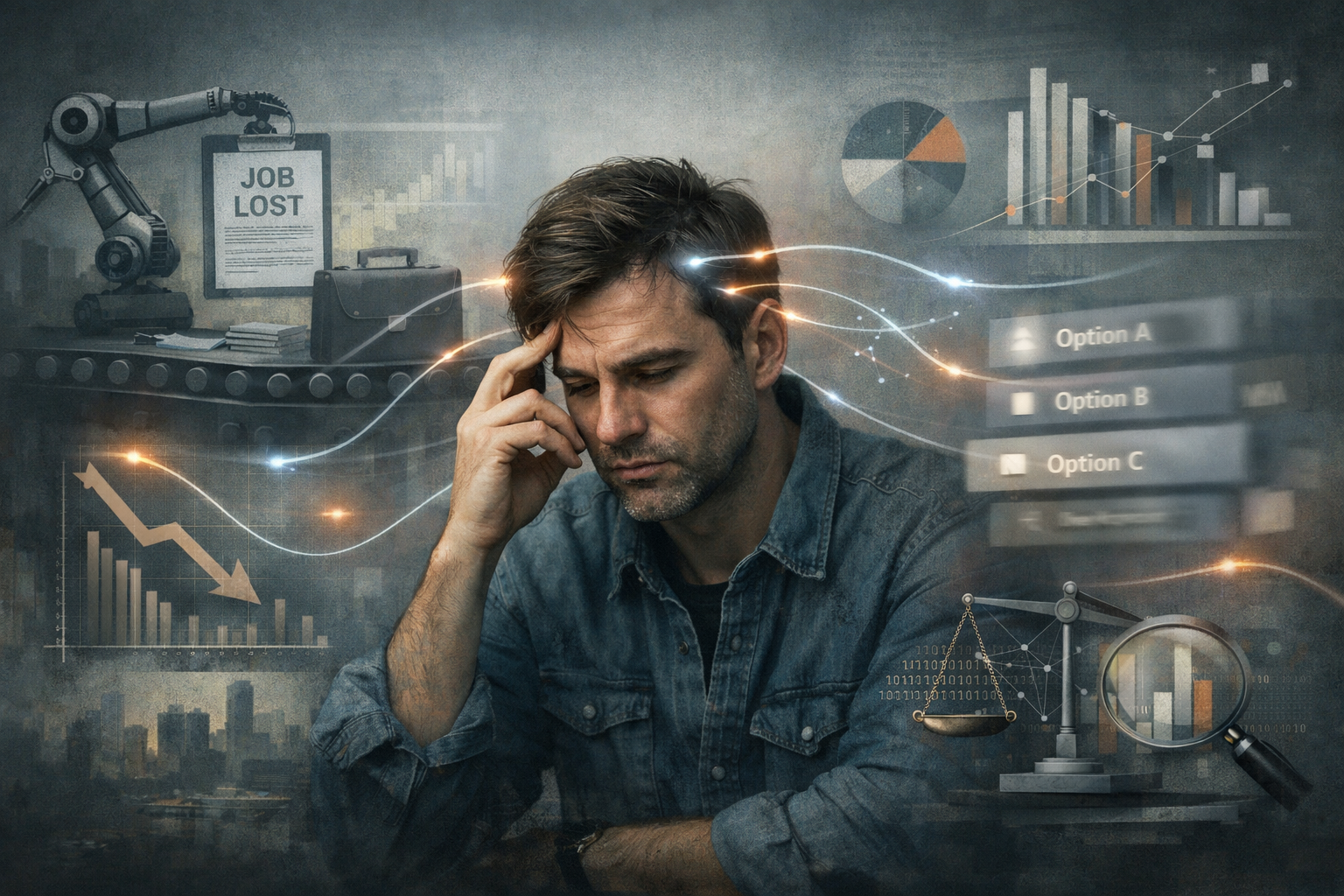
One of the most potent triggers for AI Anxiety: How Artificial Intelligence is Rewiring Your Stress Response and Decision Making is the fear of job obsolescence. Imagine dedicating years to mastering a skill, only to see an AI system perform similar tasks with greater speed and efficiency. This isn’t a distant dystopian fantasy; it’s a current reality fueling palpable concern across various professional sectors. Dario Amodei, co-founder and CEO of Anthropic, an AI company, openly admitted in January 2026 to feeling concern about AI systems potentially outperforming him in tasks central to his professional identity [3]. This sentiment isn’t isolated; highly educated professionals in law firms, government agencies, and nonprofit organizations commonly express worry about whether their expertise will remain valuable in an economy where generative AI can perform tasks currently performed by large numbers of workers [3].
This fear taps into deep-seated psychological needs:
- Identity and Purpose: Our work often forms a significant part of our identity. When that work is threatened, it can lead to an existential crisis, questioning our value and purpose.
- Financial Security: The most immediate and practical concern, the fear of losing income, can trigger profound stress responses.
- Loss of Mastery: Humans strive for mastery. That a machine can effortlessly replicate or exceed years of accumulated knowledge and skill can be deeply unsettling and erode self-efficacy.
The constant exposure to news of AI breakthroughs, coupled with personal experiences of interacting with increasingly capable AI tools, creates a fertile ground for this anxiety to take root. It’s a challenge to unlock your inner dialogue to confront these fears when the external world seems to shift so rapidly.
Decision Fatigue in an AI-Augmented World
While AI promises to simplify choices, the reality can often lead to an increase in decision fatigue. As AI generates more data, more options, and more “insights,” the human task isn’t reduced; it typically shifts to evaluating and validating AI outputs. Consider a professional who now receives AI-generated reports, recommendations, or even drafted communications. Instead of doing the initial heavy lifting, their new burden is to critically assess the AI’s work for accuracy, bias, and appropriateness.
This constant evaluative loop can be draining:
- Information Overload: AI can produce vast quantities of information. Sifting through this deluge, even if synthesized by AI, requires significant cognitive effort.
- Trust Deficit: The inherent distrust in AI’s reliability, especially concerning its ethical implications or potential for error, means every AI-generated suggestion demands human scrutiny. As a 2025 survey found, only 48% of U.S. adults are moderately confident that AI tools can provide safe and appropriate mental health guidance, highlighting a broader trust gap [2].
- The Paradox of Choice: While AI offers many solutions, the sheer volume can make selecting the “best” one more difficult, leading to paralysis by analysis.
This cognitive strain can directly affect our stress response. When our brains are constantly engaged in high-level evaluation, they deplete our mental energy, making us more susceptible to stress, irritability, and burnout. It hinders our cognitive vitality, making it harder to focus and make sound decisions. For strategies to improve your mental focus, consider exploring resources on 16 Useful Tips for Improving Your Mental Focus.
The Subtle Rewiring of Our Cognitive Biases
Artificial intelligence, designed by humans, inherently carries the fingerprints of human biases. The way we interact with AI can subtly reinforce and even rewire our own cognitive biases.
- Automation Bias: We have a natural tendency to trust automated systems, sometimes even overriding our own correct judgments. If an AI consistently provides plausible (but occasionally flawed) information, we might defer to it without critical thought, leading to poor decision-making and a reduced sense of agency.
- Confirmation Bias Amplification: AI algorithms are often designed to personalize content, showing us more of what we already like or agree with. While convenient, this can create echo chambers, reinforcing existing beliefs and making us less open to diverse perspectives. This narrowing of perspective can contribute to a rigid mindset, making it harder to navigate the complexities of connection in a diverse world.
- Algorithmic Dependence: Over-reliance on AI for tasks that require critical thinking or problem-solving can weaken our own cognitive muscles. If AI is always providing the “answer,” our ability to independently think through complex problems may diminish.
The constant exposure to AI-curated information and AI-driven decision pathways means that our internal “scripts” for processing information and making choices are being subtly reprogrammed. This unconscious rewiring can make it challenging to maintain an objective perspective and can even contribute to feelings of anxiety when faced with situations where AI guidance is absent or untrustworthy.
AI in Mental Health: A Double-Edged Sword ⚔️
The emergence of AI tools in mental health offers an interesting case study of this complex relationship. A December 2025 George Mason University survey revealed that over half (53.6%) of U.S. adults are using AI to help manage stress, anxiety, or other mental health needs, with 15% reporting daily use [2]. This adoption is highest among young adults aged 25–34, with 80% turning to AI for stress and anxiety management [2]. The perceived benefits are obvious: 24/7 availability, affordability, quick access, anonymity, and personalization [2].
However, this widespread adoption comes with significant cautions, fueling its own unique brand of AI anxiety:
- Trust Gaps and Safety Concerns: Despite usage, only 48% are confident in AI tools providing safe guidance, and 62% would still prefer a human professional [2]. A vast majority (62.5%) deem independent review or certification for safety and accuracy “vital,” yet most available tools lack such validation [2]. University of California psychologists evaluating five generative AI chatbots found poor therapeutic quality and critical shortcomings in risk assessment, especially concerning for young people [4].
- Data Security and Lack of Human Connection: Respondents also cited data security, reliability of advice, and the absence of human connection as major drawbacks [2]. This lack of genuine emotional resonance can be a significant barrier to effective mental health support.
- Regulatory Void: Industry leaders acknowledge the gap: “Many of the tools do not yet meet this bar” of safety and accuracy, underscoring an urgent need for regulatory frameworks [2]. A clinical trial (NCT07316374) is underway to examine if AI chatbots can improve anxiety-related mental health literacy, but the efficacy and safety journey is ongoing [1].
These concerns highlight a critical aspect of AI anxiety: the fear that reliance on unverified digital solutions could lead to detrimental outcomes, particularly in sensitive areas like mental health. It prompts us to deeply question how we protect our peace when technology designed to help might inadvertently cause further distress.
Cultivating Resilience: Mastering the Overwhelm in an AI-Driven World
The presence of AI anxiety—how artificial intelligence is rewiring your stress response and decision-making—is undeniable. However, acknowledging the problem is the first step towards mastering the overwhelm and navigating these complexities with greater ease. Building mental resilience in this rapidly evolving landscape requires a conscious, proactive approach that integrates psychological wisdom with practical strategies for engaging with technology.
1. Develop Digital Boundaries and Mindful Engagement 🧘♀️
Just as you set boundaries in relationships, it’s crucial to establish limits with technology.
- Scheduled Digital Detoxes: Regularly step away from AI-driven platforms and devices. Even short periods of disconnect can help reset your mental state and reduce decision fatigue. Use this time to engage in activities that nourish your cognitive vitality, such as reading for pleasure or connecting with loved ones.
- Conscious Consumption: Be mindful of the AI-generated content you consume. Question its source, its potential biases, and its impact on your mood and thoughts. Actively seek diverse perspectives rather than passively accepting algorithmic feeds.
- Intentional Interaction: When using AI tools, approach them with a clear purpose and critical lens. Understand their limitations and do not blindly trust their outputs, especially in critical areas. This conscious interaction helps you maintain agency and reduces the risk of automation bias.
- Prioritize Human Connection: Actively deepen the bond with real people. AI, no matter how advanced, cannot replicate the richness of human interaction, empathy, and genuine emotional resonance. Make time for face-to-face conversations, active listening, and shared experiences. These connections are vital for psychological well-being. For ideas on elevating your relationships, consider our article on Understanding Love Languages: Connecting with Your Partner.
2. Strengthen Emotional Intelligence 🧠
Emotional intelligence (EQ) is your superpower in an AI-dominated world. It allows you to understand and manage your emotions and to recognize and influence the emotions of those around you.
- Self-Awareness: Regularly check in with your emotional state. How is AI impacting your feelings? Are you experiencing anxiety, frustration, or a sense of inadequacy? Naming these emotions is the first step towards managing them.
- Emotional Regulation: Learn techniques to manage stress and anxiety. This could include deep breathing exercises, mindfulness meditation, or journaling. When feelings of AI anxiety arise, having a toolkit of coping mechanisms is invaluable. Our article on Simple Techniques to Release Stress, Trauma, Anxiety, and Pain can offer helpful guidance.
- Empathy and Social Skills: As AI handles more transactional tasks, human connection and empathy become even more valuable. Cultivate these skills in your personal and professional life. Understand that others are likely experiencing similar AI-related anxieties, fostering a sense of shared experience rather than isolation. You can read more about this in Emotional Intelligence—What It Is and Why It’s Important.
3. Cultivate Lifelong Learning and Adaptability 🌱
The fear of obsolescence can be mitigated by adopting a mindset of continuous learning.
- Upskill and Reskill: Instead of fearing AI, learn to work with it. Identify how AI can augment your skills, making you more efficient and effective. Focus on developing unique human skills—creativity, critical thinking, emotional intelligence, and complex problem-solving—that AI currently struggles with.
- Embrace Change as Opportunity: View the evolution of AI not just as a threat, but as an opportunity for personal and professional growth. A vision for change means adapting your “scripts” rather than clinging rigidly to old ones. This mindset fosters psychological flexibility, which is crucial for navigating uncertainty.
- Seek Knowledge, Not Just Information: In an age of abundant information, discerning true knowledge becomes paramount. Develop your critical thinking skills to evaluate AI-generated content, understand underlying algorithms, and make informed decisions. This proactive stance empowers you to “rewrite” your life scripts rather than letting them be dictated by technology.
4. Advocate for Ethical AI and Regulation ⚖️
While individual resilience is vital, addressing AI anxiety also requires systemic change.
- Demand Transparency: Support initiatives that push for greater transparency in how AI systems are designed, trained, and deployed, especially concerning mental health applications [2].
- Advocate for Certification: Echo the public’s call for independent review and certification of AI mental health tools to ensure safety and accuracy [2]. This empowers users to make informed choices and reduces the anxiety associated with trusting unverified systems.
- Engage in Dialogue: Participate in discussions about the future of AI in your workplace and community. Sharing concerns and insights can lead to collective solutions and help shape a more human-centered approach to AI development and deployment.
By adopting these strategies, you can not only mitigate the negative impacts of AI anxiety but also harness the power of artificial intelligence to enrich your life rather than diminish it. It’s about taking control, making conscious choices, and safeguarding your mental peace in an increasingly interconnected world.
Conclusion

The rise of artificial intelligence presents humanity with a profound evolutionary moment, fundamentally affecting our stress responses and decision-making processes. AI Anxiety: How Artificial Intelligence is Rewiring Your Stress Response and Decision Making is not just a passing trend; it is a legitimate psychological phenomenon stemming from valid concerns about job security, cognitive overload, and the subtle manipulation of our biases. From the C-suite executives worried about AI outperforming them to the millions of adults cautiously exploring AI for mental health support, the effects are widespread and deeply personal.
As we navigate 2026 and beyond, the imperative is clear: we must actively engage with this new reality. AkReviews believes in providing you with the tools to rewrite your life’s scripts with clarity and compassion. This means moving beyond passive apprehension to active resilience. By fostering digital boundaries, strengthening emotional intelligence, committing to lifelong learning, and advocating for ethical AI, we can cultivate a robust inner landscape capable of mastering the overwhelm. It’s about more than just surviving; it’s about thriving in an AI-driven world, safeguarding your cognitive vitality, deepening your human connections, and ultimately, protecting your peace.
The journey to self-mastery in this technological age is about understanding that while AI can amplify certain anxieties, it also provides an unparalleled opportunity to reflect on what truly makes us human—our creativity, our empathy, and our critical consciousness. Embrace the challenge, unlock your inner dialogue, and empower yourself to shape a future where technology serves humanity rather than dictates its fears.
References
[1] Nct07316374 – https://clinicaltrials.gov/study/NCT07316374
[2] New Survey Explores Promise And Peril Using Ai Managing Stress Anxiety And Other – https://publichealth.gmu.edu/news/2025-12/new-survey-explores-promise-and-peril-using-ai-managing-stress-anxiety-and-other
[3] Ai Anxiety Widespread Panic Attack Microsoft Researcher Dario Amodei – https://fortune.com/2026/01/23/ai-anxiety-widespread-panic-attack-microsoft-researcher-dario-amodei/
[4] Mental Health Optimism And The Ai Universe – https://www.mayoclinicplatform.org/2026/01/13/mental-health-optimism-and-the-ai-universe/