In the bustling digital landscape of 2026, where notifications constantly ping and social media beckons, true deep focus can feel like a mythical creature. Our attention spans are under constant assault, splintered by the endless demands of an overstimulated world. If you, like countless students, remote workers, creators, and professionals, grapple with the relentless pull of distractions, struggling to maintain concentration, and longing for a way to achieve profound productivity, then the “monk mode” protocol might be the ancient-yet-modern solution you’ve been searching for. This isn’t about retreating to a monastery forever, but a strategic, temporary, and deeply effective approach designed to help you reclaim your focus, eliminate distractions, and cultivate powerful productivity habits through deep focus techniques.
Key Takeaways
- Understanding Monk Mode: It’s a temporary, intense period of focused work, typically 3-10 days, dedicated to a single, high-priority task, involving strict elimination of distractions.
- The Dopamine Dilemma: Constant digital stimulation overloads our dopamine reward system, making it harder to sustain focus on less immediately gratifying tasks. Monk Mode helps reset this.
- Structured Routine is Key: Success hinges on a well-defined schedule, including dedicated work blocks, planned breaks, and clear boundaries around communication and entertainment.
- Environmental Control: Creating a distraction-free physical and digital workspace is crucial for preventing interruptions and maintaining concentration.
- Benefits Beyond Productivity: Beyond completing tasks, Monk Mode fosters improved cognitive performance, increased creativity, reduced stress, and the development of sustainable focus improvement habits.
The Modern Crisis of Attention: Why Deep Focus Techniques Are Disappearing


Have you ever sat down to work on an important project, only to find yourself inexplicably drawn to your phone every five minutes? Or maybe you start drafting an email and suddenly realize you’ve been scrolling through social media for the last half hour? You’re not alone. This isn’t a personal failing; it’s a systemic problem driven by the very design of our digital world. Companies intentionally craft apps and platforms to be addictive, leveraging sophisticated psychological triggers to keep us engaged, often at the expense of our ability to concentrate on meaningful work.
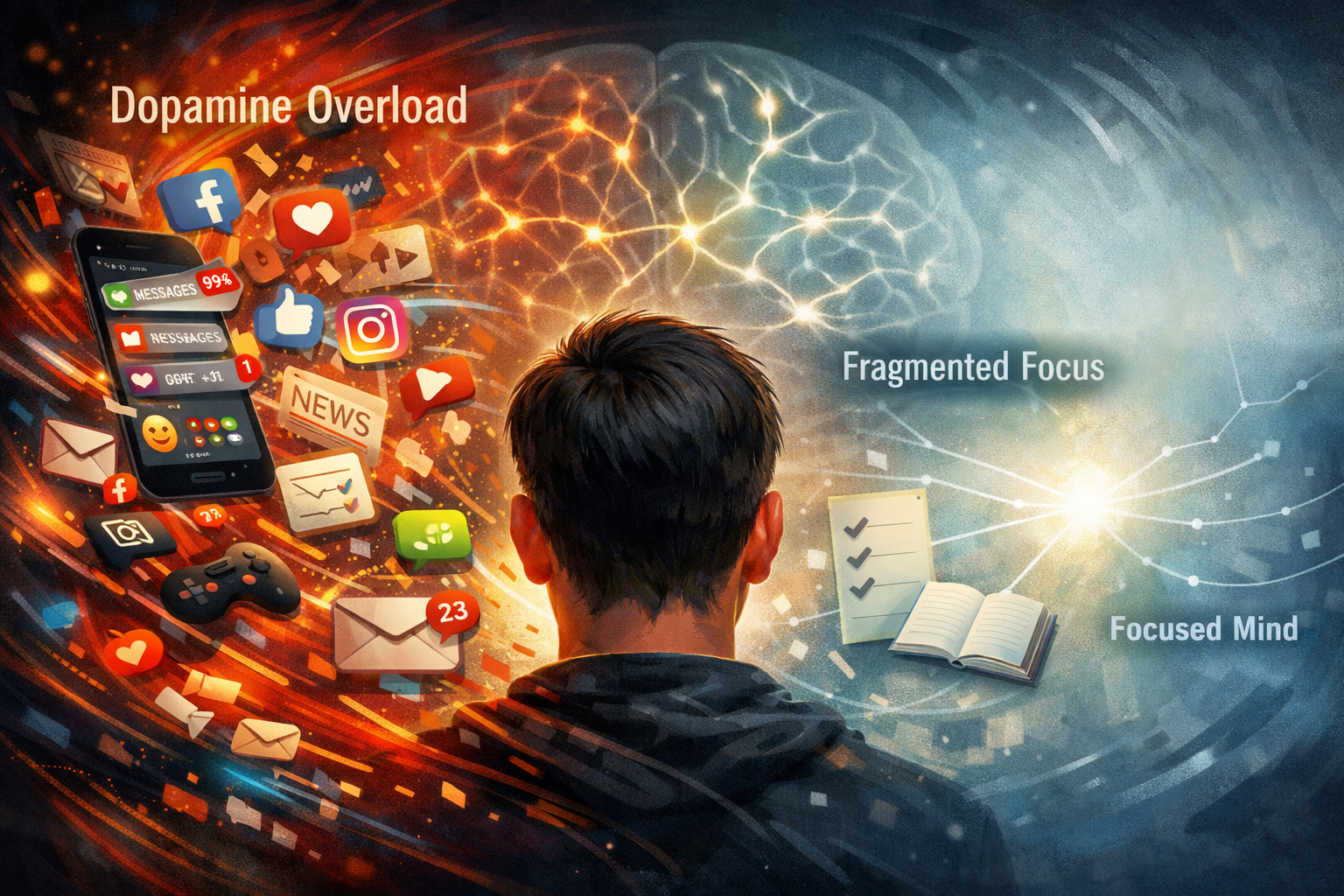
The result? A widespread crisis of attention. Our brains, once capable of sustained, singular focus, are now fragmented, constantly seeking novelty and instant gratification. This makes it incredibly difficult to engage in “deep work”—the kind of cognitively demanding tasks that produce high-quality, impactful results. This continuous partial attention diminishes our output and contributes to increased stress, burnout, and a pervasive sense of inadequacy. Many are desperately searching for effective productivity habits to counteract this relentless assault on our minds.
The Science Behind Our Distraction: Dopamine Overstimulation 🧠💡
To truly understand why the monk mode protocol is so effective, we need to talk about dopamine. Dopamine is a neurotransmitter, often dubbed the “reward chemical,” that plays a crucial role in motivation, pleasure, and learning. When you check your phone and see a new notification, receive a like on your post, or get an email, your brain releases a small hit of dopamine. This creates a powerful feedback loop: notification -> dopamine hit -> desire for more notifications.
The problem arises when we’re constantly bathed in these tiny, intermittent dopamine hits. Our brains become accustomed to this rapid-fire stimulation. When faced with a complex task that requires sustained effort and doesn’t offer immediate gratification (like writing a report or studying for an exam), our brains resist. The “reward” for deep work is delayed, and our dopamine-addicted minds perceive it as less interesting, less urgent, and frankly, less pleasurable than the next notification. This is why eliminating distractions is so critical.
Think of it like this: if you constantly eat fast food, healthy, home-cooked meals might taste bland. Your palate needs a reset. Similarly, your brain’s reward system needs a detox from constant, cheap dopamine hits. This overstimulation weakens our ability to start and sustain deep focus techniques. For strategies to help rebalance this, consider exploring natural ways to increase your dopamine levels in a healthy, sustainable manner.
What Exactly Is the Monk Mode Protocol? 🧘♂️
The monk mode protocol is a structured, temporary period of intense, undistracted focus on a single, high-priority goal. It’s a deliberate effort to create an environment and routine that mimics the solitude and concentration often associated with monastic life but applied to modern productivity. This isn’t about becoming an actual monk but rather adopting their disciplined approach to eliminate distractions and maximize output for a defined period.
Typically, a monk mode period lasts anywhere from 3 to 10 days, though some extent it for weeks. During this time, you ruthlessly cut out all non-essential activities and distractions to dedicate your energy solely to your chosen task. The goal is to achieve an unparalleled level of concentration, leading to significant progress and breakthrough insights that would be impossible in a fragmented, distracted state. It’s a powerful tool for focus improvement.
It’s NOT about:
- Permanent isolation from society.
- Ignoring all responsibilities indefinitely.
- Working 24/7 without breaks.
It IS about:
- Intentional, temporary seclusion for a specific purpose.
- Strategic elimination of digital and social noise.
- Maximizing productivity and achieving flow states.
- Training your brain for sustained deep focus techniques.
Imagine a writer needing to finish a novel, a student preparing for a crucial exam, an entrepreneur launching a new product, or a programmer tackling a complex coding challenge. These are ideal scenarios for deploying the monk mode protocol. It provides the concentrated mental space needed to tackle demanding intellectual tasks without the constant pull of the outside world. For more general advice on improving mental focus, you might find our article on 16 Useful Tips for Improving Your Mental Focus helpful.
Entering Monk Mode: A Step-by-Step Guide to Deep Focus Techniques and Eliminating Distractions 📵🗓️
Now that we understand the “why,” let’s dive into the “how.” Implementing the monk mode protocol requires careful planning and unwavering commitment. It’s about designing your environment and schedule to support unparalleled concentration. This section will guide you through the essential steps to prepare for and execute your deep focus period.
Step 1: Define Your Mission and Set Clear Goals
Before you even think about disconnecting, you need a crystal-clear purpose. What exactly are you trying to achieve during your monk mode period? Without a specific, measurable, achievable, relevant, and time-bound (SMART) goal, you’ll lack direction and motivation.
Ask yourself:
- What is the single most important project or task I need to accomplish?
- What does “done” look like for this project?
- How much time (days/hours) do I realistically need to dedicate?
- What specific deliverables will I produce?
Example Missions:
- “Write the first draft of my 50,000-word novel by Friday.”
- “Complete the architecture design and initial coding for Feature X.”
- “Study for my certification exam for 8 hours daily and complete 3 practice tests.”
- “Develop the marketing strategy and create all launch assets for the new product.”
Having a well-defined mission is the anchor for your entire monk mode experience. It dictates your actions and helps you stay on track when temptation arises.
Step 2: Plan Your Routine: Structuring Your Productivity Habits
A successful monk mode isn’t about chaotic, endless work; it’s about structured, intentional productivity. You need a detailed schedule that outlines your work blocks, breaks, meals, and even sleep. This routine creates predictability, reduces decision fatigue, and ensures you maintain physical and mental well-being. This is where solid productivity habits are forged.
Elements of Your Monk Mode Schedule:
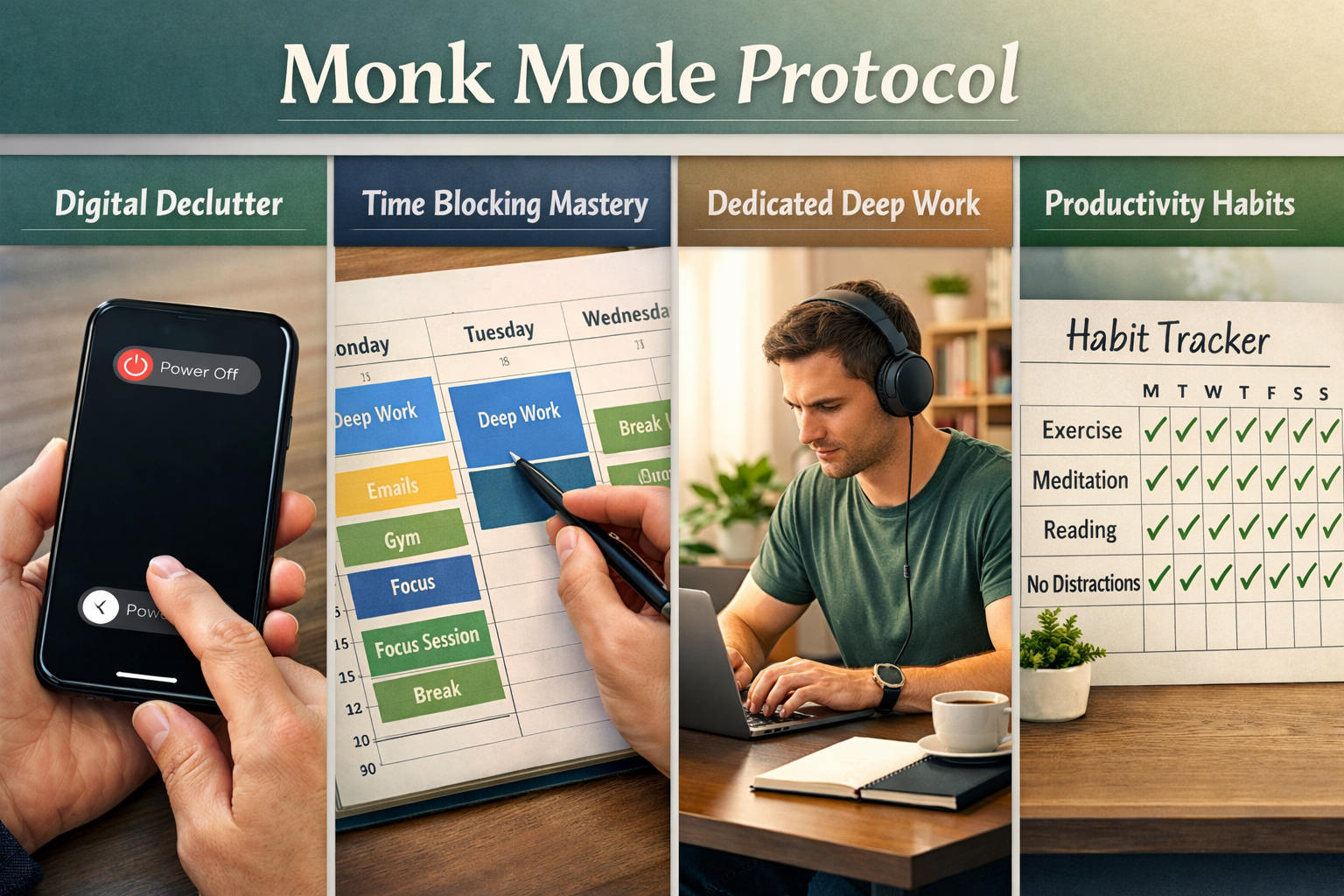
- Dedicated Deep Work Blocks: These are your sacred, uninterrupted periods of intense focus. Aim for 2-4 hour blocks, as research suggests this is optimal for deep work. Use techniques like the Pomodoro Technique (25 mins work, 5 mins break) within these blocks if needed, but extend the work periods considerably.
- Scheduled Breaks: Crucial for preventing burnout. These aren’t for checking social media! Use breaks for movement, stretching, meditation, a short walk in nature, or light reading. The goal is mental rejuvenation, not further stimulation.
- Meal Times: Plan and prepare your meals in advance to avoid wasting time and mental energy on cooking during your monk mode. Simple, nutritious food is best.
- Sleep Schedule: Do not sacrifice sleep! Adequate rest is non-negotiable for sustained cognitive performance. Maintain a consistent sleep schedule.
- Exercise/Movement: Incorporate physical activity daily. It boosts blood flow to the brain, reduces stress, and improves focus.
- “Wind-Down” Routine: Before bed, engage in calming activities like reading a physical book, journaling, or meditation to signal to your brain that it’s time to rest.
“Discipline is choosing between what you want now and what you want most.”
Step 3: Digital Minimalism and Eliminating Distractions
This is perhaps the most challenging, yet most crucial, aspect of the monk mode protocol. You must ruthlessly cut off external digital noise. This isn’t just about turning off notifications; it’s about creating an intentional information diet.
Actionable Steps for Digital Detox:
- Uninstall Non-Essential Apps: Remove social media, news, and entertainment apps from your phone. If you need them for your work, use a dedicated browser with strict time limits.
- Silence Notifications: Turn off ALL notifications on your phone, computer, and tablet. Consider “Do Not Disturb” mode or even airplane mode during work blocks.
- Block Websites: Use website blockers (e.g., Freedom, Cold Turkey) to block distracting websites during your deep work hours.
- Email Management: Only check email at designated times (e.g., once or twice a day) and only reply to essential messages. Avoid the endless inbox refresh.
- Inform Others: Crucially, inform your friends, family, and colleagues about your monk mode period. Set clear expectations about your availability. A simple message like, “I’m entering a period of deep focus for X days to work on Y project. I’ll be offline and will respond to urgent matters only at [specific time]. Thanks for your understanding!” can save a lot of headaches.
- Designate a “Communication Device”: If you must be reachable for emergencies, use a separate, basic phone or limit your main phone to calls/texts only from essential contacts.
- Physical Distractions: Declutter your workspace. A clean, organized environment reduces visual noise and cognitive load. For tips on effective study techniques that emphasize focus, refer to Secret Tips to studying effectively and prolonging your study session!.
Step 4: Environmental Control and Intentional Isolation
Your physical environment plays a massive role in your ability to focus. Just as a monk seeks a quiet sanctuary, you need to create your own.
Optimize Your Workspace:
- Choose a Quiet Location: Find a place where you won’t be easily interrupted. This could be a spare room, a dedicated corner, a library, or even a co-working space if it’s genuinely quiet.
- Ergonomics: Ensure your chair and desk are comfortable. Discomfort is a distraction.
- Lighting: Natural light is ideal. If not available, use good-quality artificial light to prevent eye strain.
- Sound: Consider noise-canceling headphones if complete silence isn’t possible. Binaural beats or ambient background noise can also help some people focus.
- Temperature: Keep your workspace at a comfortable temperature.
Minimize Social Interruptions:
- Inform Household Members: If you live with others, explain your monk mode protocol and ask for their cooperation in respecting your focused time.
- Use a “Do Not Disturb” Sign: A simple sign on your door can be surprisingly effective.
- Avoid Social Events: For the duration of your monk mode, decline non-essential social invitations. This is temporary, and your focused output will be worth it.
Step 5: Fuel Your Body and Mind 🍎💧
Your brain is an energy-intensive organ. What you consume, how much you move, and how well you rest directly impact your ability to sustain deep focus.
- Hydration: Drink plenty of water throughout the day. Dehydration can lead to fatigue and reduced cognitive function.
- Nutrition: Opt for whole, unprocessed foods. Lean proteins, complex carbohydrates, and healthy fats provide sustained energy. Avoid sugary snacks and excessive caffeine, which can lead to energy crashes.
- Mindfulness/Meditation: Even 5-10 minutes of mindfulness meditation can significantly improve your ability to concentrate, manage stress, and calm a busy mind.
- Regular Breaks: As mentioned earlier, strategic breaks are vital. Stepping away from your work, moving your body, and looking away from your screen allow your brain to rest and merge information. The importance of taking breaks cannot be overstated; read more about the benefits of taking a work break.
Step 6: Track Your Progress and Reflect
While the goal is deep work, it’s also important to track your progress. This isn’t to create another distraction but to provide valuable feedback and motivation.
- Simple Journaling: At the end of each day, quickly note what you accomplished, what challenges you faced, and what you plan to do tomorrow.
- Task Management Tool: Use a simple to-do list or project management app to check off tasks as you complete them. Seeing progress is incredibly motivating.
- Review Your Goal: Periodically check against your mission statement. Are you on track? Do you need to adjust anything?
Step 7: Transitioning Out of Monk Mode
Just as you carefully entered monk mode, you need a plan to transition out. Don’t immediately dive back into a world of endless notifications.
- Gradual Reintegration: Slowly reintroduce social media and digital entertainment. Don’t go from zero to a hundred.
- Maintain Core Habits: Try to keep some of your newly formed productivity habits. Continue with time blocking for deep work, scheduled email checks, and a distraction-free morning routine.
- Reflect and Learn: What worked well? What challenges did you face? How can you apply the lessons learned to your regular workflow? This reflection is key to long-term focus improvement.
The Profound Benefits of Embracing the Monk Mode Protocol
While the idea of intense, temporary seclusion might seem daunting, the rewards of the monk mode protocol are profound and far-reaching, extending well beyond just completing a specific task. Adopting these productivity habits can genuinely transform your professional and personal life in 2026 and beyond.
1. Unparalleled Productivity and High-Quality Output
This is the most obvious benefit. By eliminating distractions and dedicating uninterrupted blocks of time, you can achieve an incredible amount of work in a short period. Imagine compressing weeks of scattered effort into just a few highly productive days. When your brain isn’t constantly context-switching, you can delve deeper into complex problems, generate more creative solutions, and produce work of significantly higher quality. This is the essence of true deep-focus techniques.
- Example: A software developer who used to take weeks to implement a new feature because of constant meetings and notifications might complete the core coding in just a few days of monk mode.
2. Enhanced Creativity and Problem-Solving Abilities
When you’re in a state of deep focus, your brain enters what is often called a “flow state”—a mental state in which a person performing an activity is fully immersed in a feeling of energized focus, full involvement, and enjoyment in the activity’s process. This state is a breeding ground for creativity and innovative problem-solving. Without external interruptions, your mind can make novel connections, explore new ideas, and break through mental blocks that seemed insurmountable before.
3. Improved Cognitive Endurance and Attention Span
The monk mode protocol is like boot camp for your brain. By deliberately practicing sustained focus, you are actively strengthening your cognitive muscles. Over time, your attention span will naturally increase, making it easier to maintain concentration even outside your monk mode periods. It teaches your brain that delayed gratification can lead to significant rewards, effectively resetting your dopamine response. This leads to lasting focus improvement.
4. Reduced Stress and Mental Clutter
Constant task-switching and feeling overwhelmed by an endless stream of inputs are major sources of stress. When you are operating in monk mode, you have a clear mission, a structured routine, and minimal external demands. This reduces mental clutter, lowers anxiety, and provides a sense of control and calm. The focus on one thing at a time is incredibly liberating. For more insights on managing stress, consider exploring simple techniques to release stress, trauma, anxiety, and pain.
5. Development of Sustainable Productivity Habits
While monk mode is temporary, the habits you build during it are not. You learn valuable skills such as:
- Time Blocking: The ability to schedule and adhere to focused work periods.
- Digital Discipline: Recognizing and actively managing your relationship with technology.
- Prioritization: Identifying what truly matters and ruthlessly eliminating the rest.
- Self-Awareness: Understanding your peak productivity times and how different environments affect your focus.
These are invaluable life skills that can be integrated into your everyday routine, even when you’re not in full monk mode. Understanding why time management is important can further amplify these benefits.
6. A Sense of Accomplishment and Confidence
There’s an immense sense of satisfaction that comes from completing a significant project or making substantial progress on a challenging goal, especially when it felt impossible before. The monk mode protocol helps you achieve this repeatedly, boosting your confidence in your ability to tackle complex tasks and achieve ambitious outcomes. This feeling of mastery is a powerful motivator.
7. Clarity and Direction
By removing the noise and focusing intensely on one area, you gain immense clarity. You might uncover new directions for your project, identify crucial next steps, or even realize that your initial approach needs significant adjustments. This clarity often gets obscured when you’re constantly pulled in different directions.
Common Challenges and How to Overcome Them 💪
No protocol is without its hurdles. Embracing the monk mode protocol, while powerful, comes with its set of challenges. Anticipating these and having strategies in place can make all the difference between success and giving up.
Challenge 1: The Initial Withdrawal Symptoms (Dopamine Detox)
The Problem: When you suddenly cut off constant digital stimulation, your brain might rebel. You might feel restless, anxious, or bored or have an intense urge to check your phone or browse the internet. This is a normal part of the dopamine detox process.
The Solution:
- Acknowledge and Sit with It: Understand that these feelings are temporary. Don’t fight them; acknowledge them and return your focus to your task.
- Structured Breaks: Use your planned breaks to move, stretch, or meditate, which can help alleviate restlessness without resorting to digital distractions.
- Have a ‘Why’: Reconnect with your clear mission. Remind yourself why you’re doing this and the incredible outcome you’re working towards.
Challenge 2: Fear of Missing Out (FOMO)
The Problem: The anxiety that something important or interesting is happening online or socially, and you’re not a part of it.
The Solution:
- Communicate Proactively: Inform everyone beforehand about your monk mode. This sets expectations and reduces pressure.
- Delegate or Postpone: If there are truly time-sensitive matters, delegate them or postpone them until your monk mode period is over.
- Shift Perspective: Reframe FOMO as JOMO (Joy of Missing Out). Embrace the peace and productivity that comes from being disconnected. The ‘something’ you’re missing is often just fleeting digital noise.
Challenge 3: Emergencies or Interruptions
The Problem: Life happens. An unexpected family emergency, a critical work request that truly cannot wait, or a technical issue.
The Solution:
- Emergency Protocol: Have a bare-bones “emergency only” contact method for true crises (e.g., a specific ringtone for a designated emergency contact).
- Flexibility within Structure: If an interruption occurs, deal with it efficiently and then return to your monk mode with minimal fuss. Don’t let it derail your entire effort. Reset and restart.
- Pre-emptive Planning: Try to schedule your monk mode during a period when significant external demands are least likely.
Challenge 4: Burnout and Fatigue
The Problem: Pushing yourself too hard without adequate rest can lead to exhaustion, reduced performance, and a complete breakdown of your monk mode.
The Solution:
- Prioritize Sleep: Non-negotiable. Aim for 7-9 hours of quality sleep.
- Integrate True Breaks: Your breaks are for recovery, not more stimulation. Step away from the screen, move your body, and look out a window.
- Listen to Your Body: If you’re genuinely fatigued, take a slightly longer break or end your work day a bit earlier, and recommit the next day. Pushing through severe fatigue is counterproductive.
Challenge 5: Maintaining Momentum After Monk Mode Ends
The Problem: Reverting immediately to old, distracted habits once your intense focus period is over.
The Solution:
- Gradual Reintegration: As mentioned, don’t jump back into every app and notification at once.
- Identify Keeper Habits: What productivity habits did you love during monk mode? Time blocking for specific tasks? Scheduled email checks? Incorporate these into your routine.
- Schedule Mini-Monk Modes: Consider dedicating a few hours each week or a full day each month to a “mini-monk mode” to maintain your deep focus skills and eliminate distractions.
Conclusion: Building a Life of Intentional Focus in 2026
The year 2026 demands a new approach to productivity, one that recognizes the pervasive nature of digital distractions and actively works to counteract their effects. The “monk mode” protocol isn’t just a temporary fix; it’s a powerful training ground for your brain, a strategic detox from overstimulation, and a proven method to reclaim your focus, eliminate distractions, and cultivate robust productivity habits.
By consciously choosing periods of deep focus and intentional isolation, you’re boosting your output and enhancing your cognitive abilities, increasing your creativity, and ultimately, gaining a greater sense of control and peace in an increasingly noisy world. It’s about empowering yourself to decide where your attention goes, rather than letting algorithms dictate it.
Your Actionable Next Steps:
- Identify Your First Mission: What single, high-priority task could benefit most from a 3-5 day monk mode? Write it down.
- Schedule It: Block out the dates in your calendar, treating them as non-negotiable appointments with yourself and your goals.
- Plan Your Digital Detox: Decide which apps and websites you will remove or block, and communicate your unavailability to relevant people.
- Craft Your Routine: Outline your daily schedule for your monk mode period, including work blocks, breaks, meals, and sleep.
- Prepare Your Environment: Declutter your workspace, prepare simple meals, and set up your space for maximum concentration.
- Commit and Begin: Start small, learn from your experience, and embrace the power of sustained, undistracted effort.
By applying the principles of the monk mode protocol, you can move beyond simply surviving the digital age and instead thrive in it, mastering your attention and unlocking levels of productivity and creativity you might not have thought possible. The journey to focus improvement starts now.