

The year 2026 is already presenting its unique set of challenges and opportunities. Whether you’re aiming for a career shift, tackling a monumental personal goal, or simply trying to maintain consistency in your daily life, motivation can be a fickle companion. Procrastination and overthinking often stand as formidable barriers, hijacking our best intentions. But what if you could harness the power of psychological science to fuel your drive, overcome inertia, and push through the toughest obstacles? This comprehensive guide offers 26 psychology-backed ideas to motivate yourself through hard things in 2026, designed to equip you with science-based motivation hacks, effective self-talk techniques, and robust decision-making frameworks for achieving significant personal breakthroughs.
Navigating complex tasks and persistent difficulties requires more than just willpower; it demands a strategic approach rooted in how our minds work. By understanding the underlying psychological principles that govern motivation, habit formation, and resilience, you can systematically dismantle the barriers that hold you back. From leveraging the brain’s reward system to reframing negative thoughts, these expert-curated strategies provide a powerful toolkit for anyone committed to sustained progress and success throughout 2026.


Key Takeaways
- Harness Your Brain’s Chemistry: Understand and leverage neurotransmitters like dopamine through micro-rewards and positive feedback loops to build momentum.
- Master Goal Setting and Habit Formation: Employ SMART goals, the 2-minute rule, and habit stacking to make difficult tasks feel manageable and sustainable.
- Cultivate a Resilient Mindset: Utilize self-compassion, cognitive restructuring, and growth mindset principles to bounce back from setbacks and maintain a positive outlook.
- Optimize Your Environment and Support System: Structure your surroundings, seek accountability, and build a supportive community to reinforce your motivational efforts.
- Combat Procrastination and Overthinking: Apply techniques like the Pomodoro method, decision frameworks, and mindfulness to take action and reduce mental clutter.
Psychological Hacks to Ignite and Sustain Motivation in 2026
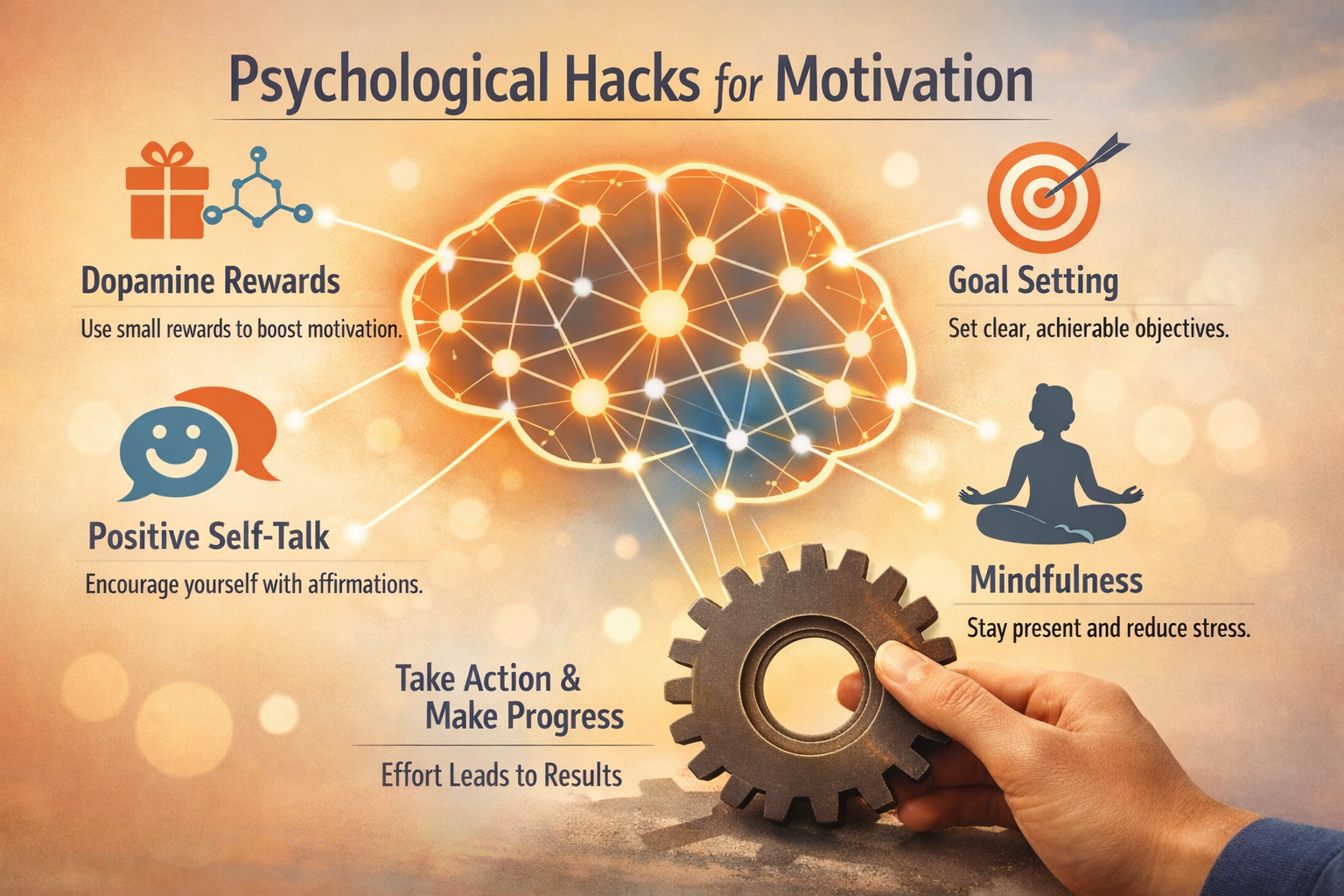
Overcoming hard things isn’t just about trying harder; it’s about trying smarter. Psychology offers a rich tapestry of insights into human behavior, motivation, and resilience. By applying these scientific principles, you can create a robust framework for consistent action, even when faced with significant challenges. Here are the first 13 of our 26 psychology-backed ideas to motivate yourself through hard things in 2026, focusing on igniting and sustaining your drive.
1. Leverage the Power of Dopamine: The Reward System
Dopamine is a neurotransmitter that plays a crucial role in motivation, pleasure, and reward. When you expect a reward, your brain releases dopamine, driving you to pursue that reward.
- Strategy: Break down large tasks into smaller, manageable steps. After completing each mini-task, give yourself a small, immediate reward. This could be a 5-minute break, a favorite song, or a quick scroll on social media. This creates a positive feedback loop, training your brain to associate the effort with pleasure, making you more likely to continue. Think of it as creating tiny victories that fuel your progress. For more insights on how to boost this crucial chemical naturally, explore “Natural Ways to Increase Your Dopamine Levels”—https://akreviews.in/natural-ways-to-increase-your-dopamine-levels/.
2. Set SMART goals (specific, measurable, achievable, relevant, and time-bound)
Vague goals lead to vague efforts. Smart goals provide clarity and focus, making the path forward less daunting.
- Strategy: Instead of “I want to get fit,” aim for “I will complete three 30-minute cardio sessions and two 45-minute strength training sessions each week for the next three months.” This specificity eliminates ambiguity and allows for tracking progress, which itself is a powerful motivator.
3. Employ the “2-Minute Rule” for Overcoming Inertia
Developed by James Clear, this rule is excellent for starting new habits or tackling daunting tasks.
- Strategy: If a task takes less than two minutes, do it immediately. For larger tasks, the rule states, “When you start a new habit, it should take less than two minutes to do.” The goal is to make starting so easy you can’t say no. For example, instead of “write a report,” your 2-minute task is “open the report document.” This lowers the activation energy required to begin.
4. Practice Habit Stacking
This technique involves pairing a new habit you want to form with an existing habit you already do consistently.
- Strategy: Identify an existing habit (e.g., “After I pour my morning coffee…”) and then stack your new desired habit on top of it (e.g., “…” I will spend 10 minutes reviewing my project plan.”).
5. Utilize Cognitive Restructuring (Reframe Negative Thoughts)
Our thoughts profoundly impact our feelings and actions. Negative self-talk can paralyze motivation.
- Strategy: Identify negative thought patterns (e.g., “This is too hard,” “I’ll never finish this”). Challenge these thoughts by asking for evidence and offering alternative, more realistic interpretations. For example, instead of “I’m overwhelmed,” try “This is a challenging project, but I can break it down into smaller steps and tackle it one piece at a time.” This shifts your perspective from helplessness to problem-solving.
6. Implement the Pomodoro Technique
This time management method uses a timer to break down work into intervals, traditionally 25 minutes, separated by short breaks.
- Strategy: Work intensely on a single task for 25 minutes, then take a 5-minute break. After four “Pomodoros,” take a longer break (15-30 minutes). This structured approach enhances focus, reduces burnout, and makes progress feel more tangible. It’s particularly effective for combating procrastination and maintaining mental focus. You might find “16 Useful Tips for Improving Your Mental Focus” (https://akreviews.in/16-useful-tips-for-improving-your-mental-focus/) beneficial here.
7. Cultivate a Growth Mindset
Developed by Carol Dweck, a growth mindset is the belief that your abilities and intelligence can be developed through dedication and hard work.
- Strategy: View challenges as opportunities for learning and growth, rather than insurmountable obstacles. Embrace effort as the path to mastery, and learn from feedback and failures. When faced with a difficult task, frame it as a chance to develop new skills, rather than a test of existing ones.
8. Practice Self-Compassion
Be kind to yourself, especially when facing setbacks or difficulties. Self-criticism can be demotivating.
- Strategy: Treat yourself with the same understanding and kindness you would offer a good friend. Acknowledge your struggles, remind yourself that imperfection is part of the human experience, and offer yourself encouragement. This fosters resilience and prevents negative experiences from derailing your motivation entirely.
9. Visualize Success (and the Process)
Mental rehearsal can prime your brain for success.
- Strategy: Don’t just visualize the outcome (e.g., reaching your goal); also visualize the process of getting there. Imagine yourself taking the necessary steps, overcoming obstacles, and feeling the satisfaction of effort. This mental walkthrough can boost confidence and prepare you for action.
10. Find Your “Why” (Purpose)
Understanding the more profound meaning behind your efforts can provide a powerful wellspring of motivation.
- Strategy: Reflect on why this hard thing matters to you. What values does it align with? How will achieving it impact your life or the lives of others? Connecting your efforts to a larger purpose can make the daily grind feel more significant and sustainable.
11. Break the Cycle of Overthinking with Action
Analysis paralysis is a common form of procrastination. The more you think, the less you do.
- Strategy: When caught in a loop of overthinking, consciously decide to take one tiny action. It doesn’t have to be perfect, just a step forward. This could be sending one email, doing one push-up, or writing one sentence. The momentum generated by even a small action can disrupt overthinking and shift you into a productive state. For more in-depth understanding on this, consider reading “Why We Overthink & How To Overcome It”—https://akreviews.in/why-we-overthink-how-to”overcome it/.
12. Create an “Implementation Intention”
This involves making a specific plan for when and where you will perform a particular action.
- Strategy: Instead of a general intention like “I’ll work on my project,” form an implementation intention: “When it’s 9 AM on Monday, I will sit at my desk and work on my project outline for 45 minutes.” This pre-decision removes the need for willpower in the moment and makes you more likely to follow through.
13. Gamify Your Progress
Turn your challenging tasks into a game.
- Strategy: Award yourself points for completing tasks, create levels, or set up a streak challenge. Track your progress visually with charts or apps. The element of play and competition (even with yourself) can make arduous work more engaging and provide continuous mini-rewards.
Advanced Self-Talk, Decision-Making, and Environmental Hacks for Personal Breakthroughs in 2026
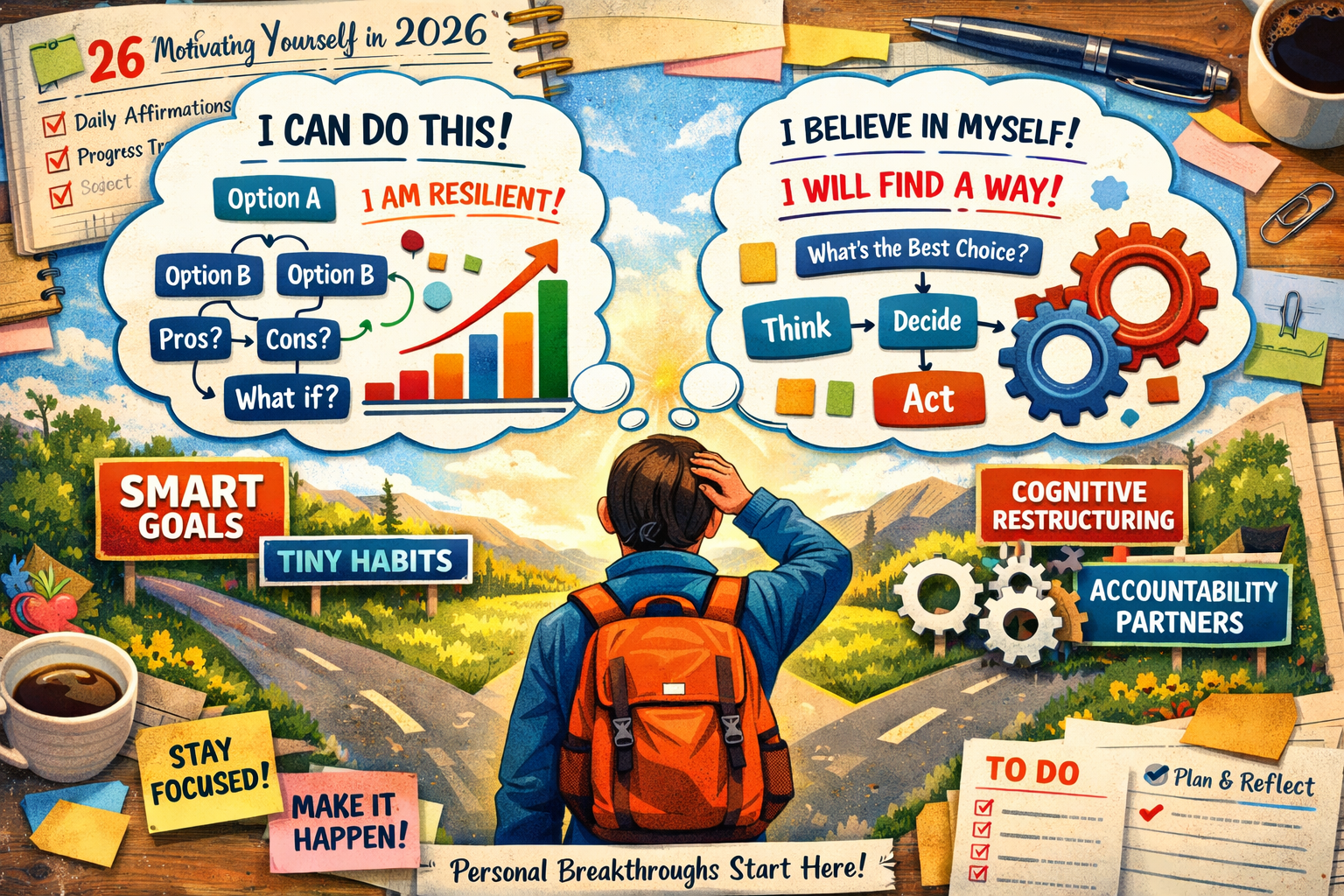
Moving beyond the initial sparks of motivation, sustained effort through hard things requires sophisticated strategies for self-regulation, wise decision-making, and an optimized environment. These next 13 of our 26 psychology-backed ideas to motivate yourself through hard things in 2026 delve into deeper psychological principles that foster resilience, reduce mental friction, and build lasting behavioral change.
14. Practice “Future Self” Visualization
Think about whom you want to be in the future and align your current actions with that vision.
- Strategy: Regularly take time to imagine your future self, having achieved your goals. How do they feel? What do they do differently? Then, ask yourself, “What would my future self do right now?” This creates a powerful connection between your present efforts and your desired future, making difficult choices easier by framing them as investments in your ideal self.
15. The “Done is Beyond Perfect” Principle
Perfectionism is a common cause of procrastination and can stifle progress.
- Strategy: Focus on completing tasks to a sufficient standard, rather than striving for unattainable perfection. Recognize that iterative improvement is often more effective than endless delays. Submitting a “good enough” first draft is far more productive than never starting because you fear it won’t be perfect. This approach encourages action and learning through completion.
16. Seek Accountability
Knowing someone else is tracking your progress can be a powerful motivator.
- Strategy: Share your goals with a trusted friend, mentor, or join an accountability group. Schedule regular check-ins to report on your progress. The desire to avoid letting others down (or to impress them with your progress) can provide an external push when internal motivation wanes. This is a key aspect of how to become a self-leader.
17. Eliminate Decision Fatigue
The more decisions you have to make throughout the day, the less willpower you have for important tasks.
- Strategy: Automate or pre-decide as many minor choices as possible. Plan your outfits, meals, and daily schedule in advance. This reserves your mental energy for the critical decisions and tasks related to your hard things.
18. Use Social Proof (Positive Peer Influence)
Humans are social creatures, and we are often influenced by what others do.
- Strategy: Surround yourself with people who are also working towards their goals or who have already achieved what you aspire to. Their success and work ethic can inspire and normalize the effort required. Join communities or follow individuals who embody the qualities you want to cultivate.
19. Implement the “Seinfeld Strategy” (Don’t Break the Chain)
Comedian Jerry Seinfeld famously advised a young comedian to mark an X on a calendar for every day he wrote jokes. The goal was to “not break the chain.”
- Strategy: Choose a small, consistent action related to your goal (e.g., “write for 30 minutes,” “study for 1 hour,” or “exercise”). For every day you complete it, mark it on a calendar. Your motivation then shifts to maintaining the streak, building powerful momentum, and making consistency its reward.
20. Optimize Your Environment
Your surroundings significantly affect your focus and motivation.
- Strategy: Design your workspace to minimize distractions and support your goals. Remove clutter, turn off notifications, and ensure necessary tools are readily available. Similarly, make positive actions easy and negative ones difficult. If you want to exercise more, lay out your workout clothes the night before. If you would like to eat healthier, keep healthy snacks visible and unhealthy ones out of sight.
21. Practice Mindfulness and Present Moment Awareness
Overthinking about the past or worrying about the future can drain your energy and motivation.
- Strategy: Engage in mindfulness practices like meditation or deep breathing exercises to bring your attention to the present moment. This helps to reduce anxiety, improve focus, and prevent your mind from wandering to counterproductive thoughts, making it easier to tackle the task at hand. Learning to stop worrying about everything is crucial for living fully. Find more insights on this here: Stop Worrying About Everything and Live Today to the Fullest.
22. Focus on “Process Goals” Over “Outcome Goals”
While outcome goals are important, focusing too heavily on them can be demotivating if progress is slow or setbacks occur.
- Strategy: Shift your attention to the daily or weekly actions (process goals) that lead to your desired outcome. For example, instead of “lose 20 pounds (ca. 9 kg),” focus on “exercise 4 times a week and track all meals.” Celebrating consistency in your process makes you feel successful along the way, maintaining motivation through the long haul. This aligns with many powerful strategies to motivate yourself to exercise.
23. Understand the Zeigarnik Effect
This psychological phenomenon suggests people remember unfinished or interrupted tasks better than completed ones.
- Strategy: If you’re struggling to start a big task, begin it, even if it’s just for a few minutes, and then intentionally stop before you’re done. Your mind will retain a subconscious tension around the unfinished task, making it easier to pick it up again later. This is an excellent hack for breaking through procrastination.
24. Acknowledge and Journal Your Progress
Underestimating how far you’ve come can be demotivating.
- Strategy: Regularly review your achievements, no matter how small. Keep a progress journal where you document successes, challenges overcome, and lessons learned. This tangible evidence of your effort and growth provides a powerful morale boost and reinforces your ability to tackle hard things.
25. Use the “Sunk Cost Fallacy” to Your Advantage (Cautiously)
While typically a cognitive bias to be avoided, in some contexts, having invested time or effort can motivate you to continue.
- Strategy: If you find yourself waning, briefly reflect on the effort you’ve already put into the task. For some, the thought of “wasting” that past investment can provide a gentle nudge to continue, especially when you’re close to a breakthrough. However, use this cautiously and ensure you’re not continuing a truly lost cause.
26. Incorporate Regular Breaks and Rest
Burnout is the enemy of sustained motivation.
- Strategy: Schedule regular breaks throughout your workday and ensure you get adequate sleep. Rest is not a luxury; it’s a critical component of productivity and mental resilience. Your brain needs time to merge information and recharge, allowing you to return to hard tasks with renewed energy and focus. The benefits of taking a work break are profound and can significantly boost productivity and relieve stress, as highlighted in “The Benefits of Taking a Work Break: Boost Productivity and Relieve Stress! »” — https://akreviews.in/the-benefits-of-taking-a-work-break-boost-productivity-and-relieve-stress/.
Conclusion
Motivating yourself through hard things in 2026 doesn’t have to be a constant uphill battle against your mind. By understanding and applying these 26 psychology backed ideas to Motivate Yourself Through Hard Things in 2026, you can transform your approach to challenges, turning procrastination and overthinking into deliberate action and sustainable progress. From harnessing the power of dopamine and setting SMART goals to cultivating a growth mindset and optimizing your environment, each strategy offers a scientifically proven pathway to enhance your drive and resilience.
The journey through arduous tasks is often long, but with these tools, you are better equipped to navigate it. Remember, consistency trumps intensity. Pick a few strategies that resonate most with you and start implementing them today. Don’t be afraid to experiment and adapt them to your unique circumstances. Your ability to overcome obstacles, achieve significant personal breakthroughs, and truly thrive in 2026 lies not just in your ambition, but in your strategic application of psychological insights.
Actionable Next Steps:
- Select 3-5 Strategies: Review the 26 ideas and choose 3 to 5 that you believe will have the most immediate impact on your current challenges.
- Create an Implementation Plan: For each chosen strategy, write down exactly how you will apply it. Use the “Implementation Intention” (Idea #12) to specify when and where you will take action.
- Track Your Progress: Keep a simple journal or use a calendar to mark your progress (Idea #24, #19). Celebrate small wins to keep your dopamine flowing.
- Seek Support: Share your goals and chosen strategies with a trusted friend or mentor to incorporate accountability (Idea #16).
- Reflect and Adjust: Regularly (e.g., weekly) assess how the strategies are working. What’s effective? What needs tweaking? Be flexible and willing to adapt.
By embracing these psychological insights, you are not merely trying to motivate yourself; you are strategically engineering your environment, mindset, and behaviors for success. Here’s to a year of purposeful action and remarkable achievements in 2026!